


Howdy, Wealth Writers🤠
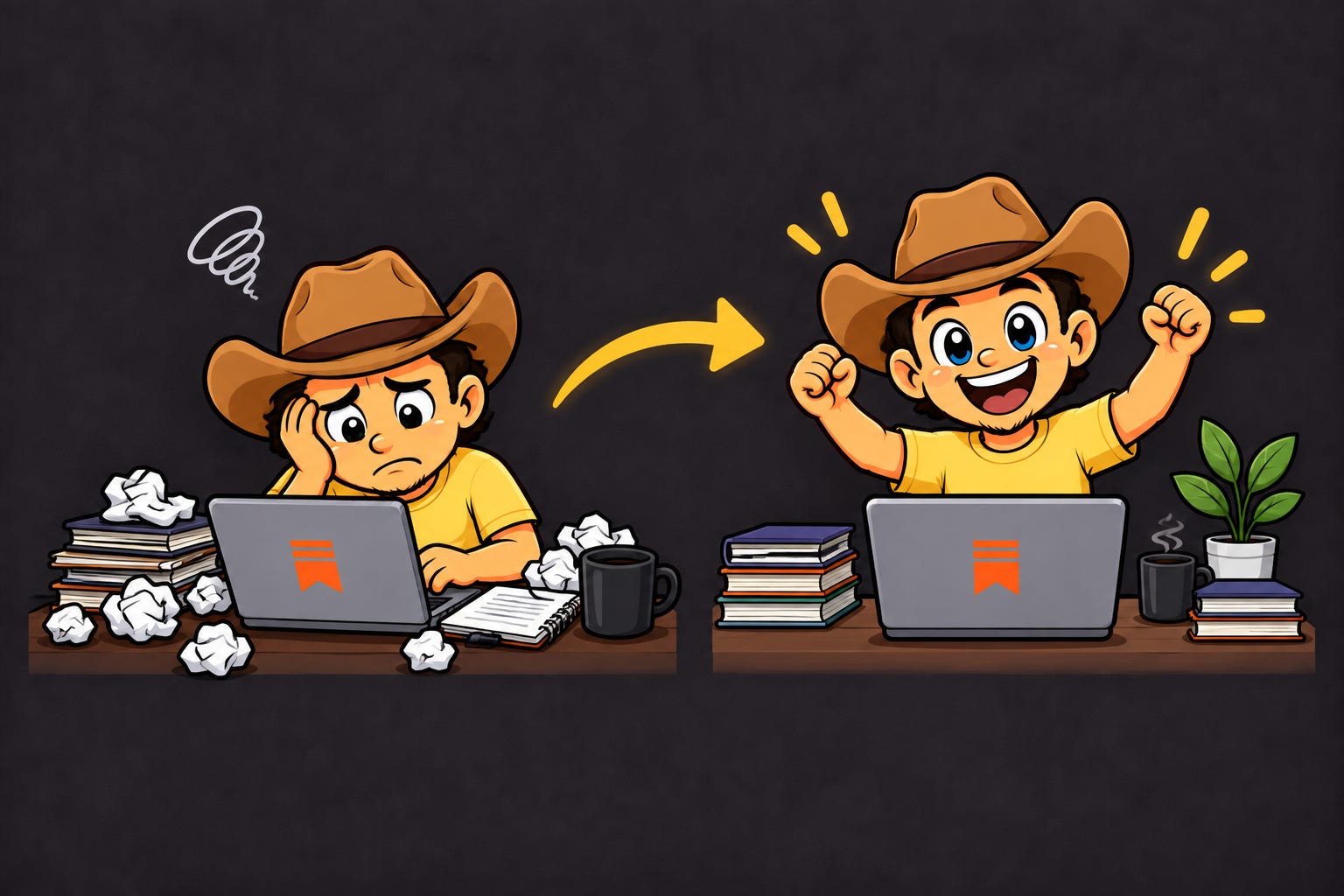
One year ago, I left 4K+ followers and 13M+ views on X behind.
I moved my entire creator business to Substack.
And over the next 12 months, I learned 308 things I wish someone had told me before I started.
I wrote 80+ articles.
Sold 100s of digital products.
Ran the business while living around Southeast Asia.
And somehow kept it running through three months of military training.
Some of these lessons cost me money.
Some cost me time.
A few probably saved me months.
So I’m putting all 308 in one place.
Let’s goo! 🤠

Table Of Contents
The Mindset That Kept Me Going
1. The comparison spiral costs more than a bad mood.
Seeing someone else celebrating their viral win is what talks you out of posting that day, and skipped days are what actually kill momentum.
2. A quiet week isn't a verdict on your work.
Algorithms swing on their own schedule; one dead week after a great one is normal, not a sign to change strategy.
3. Scrolling time is opportunity cost, not neutral rest.
Two hours a day adds up to 36 days a year that could've gone into a article or product.
4. When your income depends on being visible online, the mental toll hits harder.
The same feed that connects strangers can quietly drain the person relying on it to earn a living.
5. "Just checking one thing" is how hours disappear.
The infinite scroll trap costs you the exact time you should use to create content yourself.
6. Most growth advice is written by people with far more free time than you have.
Advice to post daily notes and engage for hours assumes 40 free hours a week; with 90 minutes after work, running that playbook just burns you out faster.
7. As a side-hustle creator, you're fighting three constraints at once (time, energy, and attention)
Full-time creators can optimize for output because those constraints don't bind them the same way; you have to optimize for what you can sustain instead.
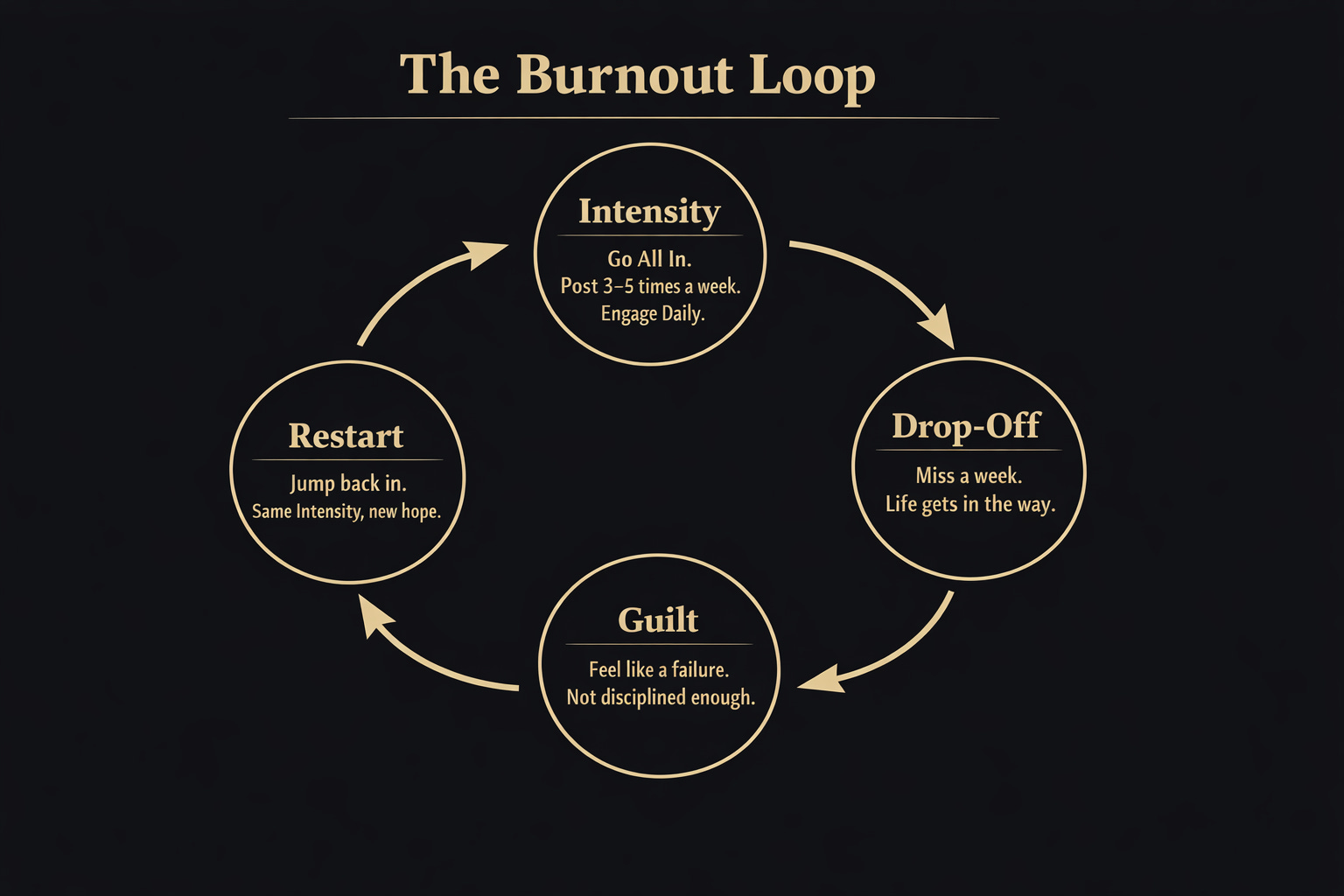
8. The Burnout Loop measures success by intensity, and that's exactly why it ends in guilt and quitting.
Chasing how much you did this week instead of whether you'll still be doing it in six months is what drains people until they quit.
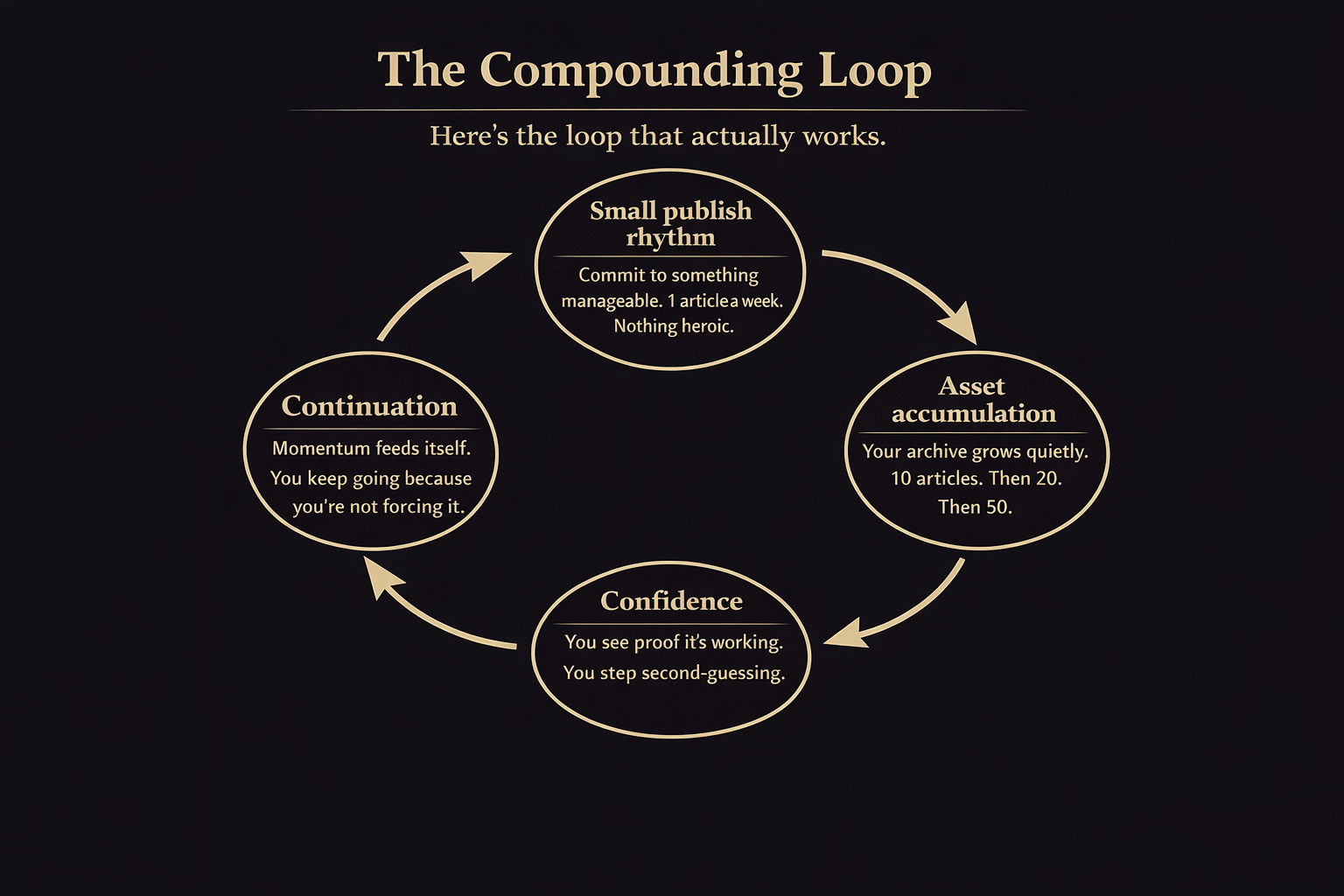
9. The Compounding Loop measures success by continuity, not intensity.
The real question is whether you can still do this in 6 months, and that's the loop that actually builds a business.
10. Building a Substack business realistically takes 2-3 years, not 6 months.
Treat any early spike of income or growth as proof of possibility, not proof you can quit your job yet, chasing a lucky break as if it were a system is how people crawl back to a 9-5 with drained savings.
11. Run everything you do through one filter: can I do this consistently, and does it give me leverage?
That's why I skip hours-long custom thumbnails and daily notes, and instead write evergreen articles and repurpose my notes from my articles instead.
12. Test the thing that scares you once before deciding it's not for you.
Going live and showing my face felt like everything I didn't sign up for, but I did my first live video anyway, survived it, and actually enjoyed the conversation.
13. The "someday" mindset is what keeps a side hustle a side hustle forever.
Telling yourself "I'll commit once this really works" or "once my job calms down" all really means "my dream can wait" and so the dream always ends up waiting.
14. Your job feels safer than your business, but it isn't.
Nobody can fire you from something you own. Every subscriber, product, and article you build stays yours and compounds, while a job's stability can disappear with one mail from HR.
15. Commitment means using your free hours with intention, not grinding through the night.
My own version: planning the week's content Sunday morning, noting ideas during a 20-minute work break, and writing one full article in 45 minutes after dinner. Not 4am wake-ups, and staying up the whole night to just hustle through it.
16. Define your exit with two specific numbers instead of leaving it vague.
1. Your safety net (months of expenses you need saved before leaving feels safe) and 2. your income floor (what your business needs to earn monthly before it can replace your job).
17. Numbers you can't see don't keep you motivated.
I kept my own exit numbers inside, the content system I already open every time I work on my newsletter, so I see exactly what I'm building toward every time I sit down.
18. Diagnose your own motivation before starting anything. Money alone won't carry you through it.
My first business, an e-commerce store at 18, collapsed within months not because the model was bad, but because I only cared about the money, not the work itself.
19. Not fearing failure is trained through repetition, not something you're born with.
I built over 45 digital products, wrote 25+ threads that flopped, and ran mail sequences that made zero dollars. Doing that much unrewarded work is what hardened me into someone who doesn't take a miss personally anymore.
20. You're more capable than you think, and you only discover that by doing something before you feel ready.
My business coach dropped me four weeks into a paid, year-long mentorship. Having no mentor, course, or playbook left is exactly what forced me to build my first coaching offer entirely from scratch.
21. Two rejections in a row don't mean the idea is dead.
I got told "no" on my first two sales calls for my coaching offer and had already mentally filed the whole idea as "didn't work out" before my third call said yes.
22. Test whether your systems actually hold up under real constraints instead of just assuming they need free time.
I deliberately signed up for three months of military reserve training to stress-test my own Substack growth systems under a rigid schedule, and my business grew faster in those three months than ever before.
23. A missed day doesn't need to be made up or apologized for, just pick the schedule back up the next day.
All-day missions wiped my schedule entirely, a lack of WiFi meant buying and working of my mobile hotspot, and no laptop meant answering DMs from my phone instead, none of it became a excuse to not make progress.
24. Reframe your day-job paycheck as business investment capital instead of just a burden you tolerate.
The extra income from my military work stacked on top of my business income, and I put a chunk of that combined total back into business investments.
Know somebody that could benefit from these lessons? :)
Sharing is caring and fully free of charge👇 :D
How I Positioned Myself
25. Clarity about what makes you different is magnetic.
Weave it into your bio, banner, and every post so it's obvious within seconds of landing on your profile.
26. Vanity metrics lie.
10,000 ghost subscribers will never outperform 1,000 people who actually act on what you say.
27. Reputation is the one asset that can't be rebuilt fast.
One promotion for something you don't actually believe in can erase months of trust in a single post.
28. People subscribe to a person before they subscribe to a topic.
Nobody subscribes just because I reached 13 million people or sold over 7,000 products, they subscribe because a guy quitting his life in Germany for a one-way ticket to Bali is a story they actually want to follow. :)
29. Named credibility does heavy lifting.
Working with someone like Chris Orzechowski or getting a nod from a recognized name like Pascio builds trust faster than another stat ever could.
30. The generic wisdom big creators post today isn't what made them big.
Nicolas Cole didn't blow up posting "focus on providing value," and Justin Welsh didn't grow saying "your network is your net worth". That advice only sounds obvious now because it's been recycled thousands of times since.
31. A Target Persona has to answer one very specific question.
“Write for your past self” is too fuzzy to act on. The real question is how one specific person, with one specific pain, gets one specific result through one specific solution.
32. Interview your actual readers instead of guessing who they are.
My own DM script to warm leads: “Would you be down to jump on a quick call so I could fully understand your situation... I will not try to sell you anything.”
33. Get a free, full transcript of a reader call instead of relying on notes.
My exact stack: record with BlackHole, upload the video unlisted to YouTube, then paste the link into YouTubeToTranscript.com for a free transcript.
34. Feed reader transcripts to AI to build a real Target Persona doc.
Force ChatGPT to fill out sections like Core Fears, Emotional Triggers, and Language & Tone Guidelines using only what the reader actually said, then I save the file permanently to reference it for all your future content
Your Target Persona work is the foundation for your whole Substack Biz.
35. List your anti-values, not just your values.
Knowing what you refuse to be (gatekeeping, hype culture, burnout glorification) sharpens your brand as much as knowing what you stand for.
36. Pick 3-5 mentors and study why their work resonates.
Break down their worldview, tone, and visuals, then remix the traits you admire into your own combination.
37. Your personality is the one asset that can't be commoditized.
OpenAI runs on Sam Altman, Tesla and X run on Elon. A face sells better than a logo, and for a solopreneur, personality costs nothing to build and works across every product you ever launch.
38. Keep the "unprofessional" thing that makes you memorable.
Even my own mentor told me to drop the “🤠” emoji and cartoon profile picture for something more polished. I refused, because that's exactly what people remember me for.
39. Your personal brand doesn't need a product yet. it IS the product while you build trust.
Long before I ever pointed a reader to an offer, I was writing personal stories on about missing a taxi at the beach or getting salmonella, because that's what built the trust to later sell.
40. Once trust exists, one line converts.
After building that audience on personal stories, I simply said, "Want to write viral stories like me? Check out my AI tool"
41. A personal brand is the one business model that doesn't require skill or capital before you start.
Freelancing needs you to already be good enough to get paid, a SaaS needs you to code or fund a developer, an agency needs real know-how. A personal brand just needs you to document your journey publicly while you're still a beginner.
42. Trust built once compounds across every offer you launch after it, so you never start from zero again.
I went from a course, to coaching, to further products without rebuilding an audience each time, because people who already trusted my judgment from my earlier personality-driven content followed me into each new thing.
43. Your voice keeps developing well past your first few months of writing, not just at the start.
Even after more than 80 published articles, my writing still shifts week to week as I keep figuring out what genuinely sounds like me versus what doesn't.
44. Figure out your specific personal-brand markers instead of guessing at them yourself.
Reject generic statements like "I'm passionate about X" and keep pushing deeper until something specific surfaces that a stranger would actually remember you for.
Subscribe now for weekly value bombs + FREE access to the 5-Day Substack Side-Hustle Sprint
How I Turned My Profile Into A Conversion Machine
45. Your public profile name and your publication name do two different jobs.
Use your newsletter name for the newsletter, but use a real, human-sounding personal name for your own profile.
46. Keep your Handle clean, but let your Name field carry your signature.
My Handle is plain ("timomason") for tagging, but my Name is "Timo Mason🤠". The cowboy emoji is what makes me impossible to miss whenever anyone mentions me on Substack.
47. You don't need your real legal name, you need a name that sounds like a real human's.
"Timo Mason isn't even my real name" but it works because it's findable and reads like a person, not a brand.
48. Your profile name is internal Substack SEO.
I learned this trying to find a client's own Substack profile by searching her real name and failing, because her profile name wasn't personal.
49. A bad profile picture sends signals before anyone reads a single word.
Low resolution says you don't sweat details, an unclear face keeps people from connecting, and a background color that clashes with your brand quietly erodes trust without the visitor knowing why.
50. Show your face, cropped tight enough that it fills most of the frame.
A tiny full-body shot in the distance has already lost the visitor before they've considered subscribing.
51. Match your profile picture's background to your publication's actual brand colors.
I pull my exact color codes from Website Editor → Colors and set that as my profile picture background using the free tool picofme.io.
52. The first thing your profile description has to answer is whether it’s for the reader at all.
“Is this for me” is the exact question running through their head in the first half-second.
53. Second, tell the reader why they should care.
If the answer to the first question is yes, this is the line that keeps them reading instead of scrolling past.
54. Third, tell the reader how you’ll actually get them there.
This is where you name the actual mechanism, not just repeat the promise.
55. Last, tell the reader why they should listen to you specifically.
What makes you different from all the other experts in your niche?
56. Skip naming your audience directly if a shared feeling does the targeting for you.
My own bio says "I help you escape the 9-5 hell..." instead of naming a demographic. If the line resonates, the reader already knows they're the right person.
57. Every extra link below your bio is an open exit door.
I keep exactly one (my own publication) cause the only job of a Substack profile is turning a visitor into a subscriber, not routing them to Instagram.
How I Built The Subscriber Journey On My Website
58. Every single visitor to your Substack lands on your welcome page before anything else.
If that page isn’t doing its job, you’re leaking subscribers every day without ever seeing it happen.
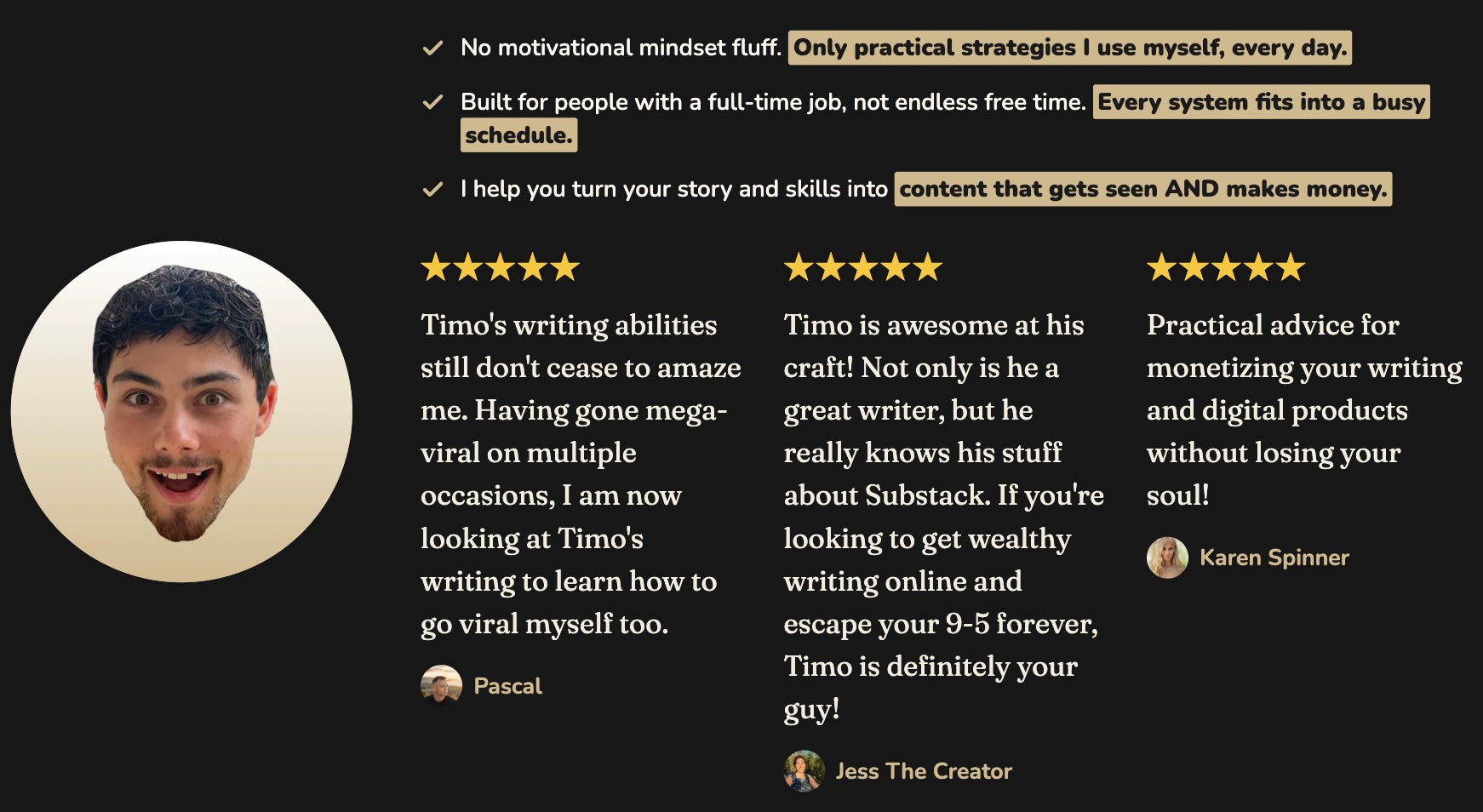
59. A welcome-page visual with real social proof converts better than just your profile picture.
My welcome page ran on my profile pic alone for a long time. I fed Claude Design my actual reader testimonials plus bullet copy and replaced it with a visual that shows proof, instead of just my face.
60. A welcome page needs a clear outcome.
Weak: “Welcome to my newsletter.”Strong: “Build and publish your Substack the right way from day one.”
61. A welcome page needs a specific audience signal.
Weak:“For anyone interested in writing.” Strong: “For creators who want to start a Substack, but feel stuck before publishing.”
62. A welcome page needs a simple result-based reason to subscribe.
One sentence that says exactly what the reader gets like: “Get step-by-step frameworks to go from idea → published.”
63. Substack’s testimonial feature for your welcome page is buried where almost nobody looks.
It’s not in the Welcome Page editor, it lives under Recommendations → “Manage Recommendation Blocks” which is why 95% of creators never even find it.
64. Make your welcome page’s “skip” button feel like a small loss instead of an exciting option.
I caught a client’s welcome page using “Let me see the content :D” as the skip CTA, which basically tells the visitor “no need to subscribe”. I swapped it for something flat like “I’m not interested” instead, since the experience is identical either way except one path leaves them subscribed.
65. Your homepage has exactly two jobs.
1. Pull a visitor deeper into your content, 2. turn them into a subscriber.
66. Disable Notes, Chat, Archive, and Leaderboard from your nav bar.
These default tabs are either redundant with your profile or irrelevant to 99% of visitors.
67. Replace the default Archive with tagged content-bucket pages.
A visitor who found you through one specific topic stays engaged with exactly that topic instead of landing in a random chronological dump of everything you've ever written.
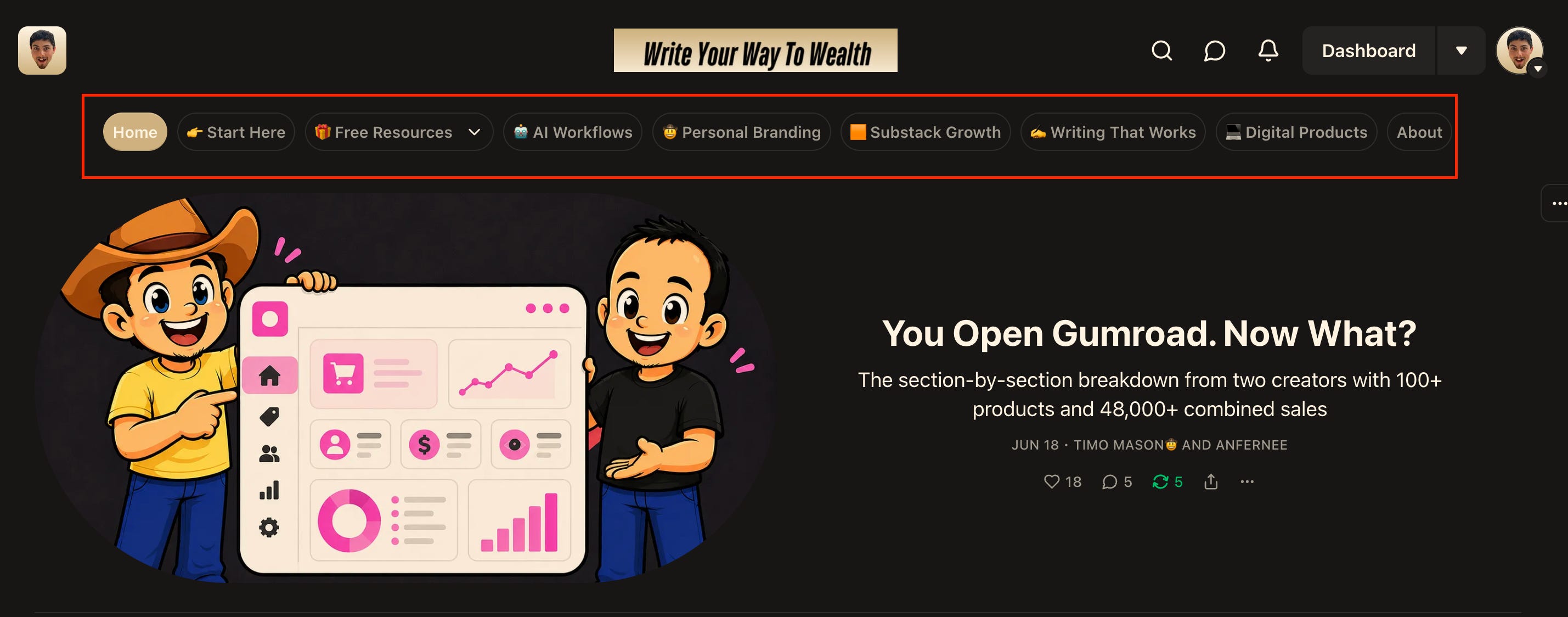
68. Turn on "custom body layout" in the Website Editor.
It's one hidden toggle buried in the sidebar that unlocks full control over your homepage. Skip it and none of the other homepage settings are available.
69. Write a separate Subscribe block pitch for your non-subscribers.
This one has to justify the actual sign-up decision.
70. Write a individual upgrade nudge for your free subscribers in the subscribe block.
This one just has to remind them what they’re missing without repeating the whole pitch.
71. Write a simple thank-you message as the subscribe block copy for your paid subscribers.
This one isn’t selling anything, it’s just confirming they made the right call.
72. Your logo doesn't need custom design work to look intentional.
I just reused my existing Substack profile picture as my homepage logo, and it works fine.
73. Isolate your one accent color to just the Subscribe button.
When everything else on the page is black, white, or gray, the eye goes to the only colored element without even trying.
74. Pin your best entry-point content to the hero position instead of your latest post.
The hero should serve a brand-new visitor first, not reward existing readers with whatever's most recent.
75. Write your Subscribe pitch as a single outcome promise.
One sentence that says exactly what the reader gets beats a list of credentials every time.
For the full Substack homepage breakdown, check out this article.
What I Learned About The Perfect Welcome Mail
76. A "thanks for subscribing, see you Thursday" welcome mail is a receipt, not a welcome.
It only answers "did it work?" and gives the reader nothing to remember you by.
77. One welcome mail isn't a system, it's a hope.
The creators who actually convert free readers to customers have a deliberate sequence of mails that each do a specific job, not a single mail followed by silence.
78. Give before you ask.
Deliver the free resource you promised first, then explain your credentials. Value that lands before the pitch makes the credibility section feel like context instead of an audition.
79. Reframe your deliverability ask as an obviously lopsided trade.
"It takes you 12 seconds to reply, this newsletter takes me 2 hours to write" makes a small request feel fair instead of naggy.
80. Name your readers something, and they'll act like it.
"You're officially part of the Wealth Writer Gang" turns a passive subscription into an active membership. Readers who accept the label engage more because they're now behaving consistently with who they were just told they are.
81. Don't bury your best work in the archive. Hand new subscribers your greatest hits immediately.
A new subscriber has no idea your best posts exist; they subscribed because of one thing that caught their eye, so direct them to your top-tier posts in the welcome mail.
82. An origin story in a welcome mail only earns its place if it mirrors the reader's own situation back to them.
"I grew up in a small town and always loved writing" means nothing to a stranger. It only works when it makes the reader feel seen, not when it's a biography exercise.
83. Frame a welcome sequence as a finite course instead of an open-ended newsletter subscription.
Nicolas Cole’s "I'll be your mentor over the next 5 days" line sets a completion expectation that a “subscription” never can. “Students” show up for lessons with a commitment, mere“subscribers” don’t have.
84. Position yourself as a fellow explorer instead of the guru with all the answers.
DAN KOE opens with "I'm as much of a beginner as you are, so we're exploring this together," which pulls in readers who value authentic inquiry over confident instruction.
How I Pimped Up My Substack
85. Diagnose which track you’re on before you ever open Claude Design.
There are only two starting points: you already have a brand, or you’re starting from zero, and each one needs a different first move.
86. If you already have a brand, just upload your guide, logo, URL, and hex codes.
Claude Design can build from what already exists instead of guessing at your visual identity from scratch.
87. If you’re starting from zero, do the prep first.
One sentence on what you do, three colors, two fonts, your logo, and a style sentence.
That’s the minimum foundation Claude Design needs before you generate anything.
88. AI defaults to average without a brand foundation to work from.
Skip the prep step and you’ll get generic, forgettable output no matter how good the tool is.
89. Review Claude Design's first draft like a critical client, never on autopilot.
Across more than 20 client builds, Pinkie from AI Meets Girlboss 🦩 says Claude has never gotten the brand system right on the very first pass, even with detailed guidelines attached. Vague feedback gets a vague second draft, so name exactly what's off.
90. Claude Design and Canva aren't competitors. One decides the system, the other executes it daily.
Build your brand system once in Claude Design, then export it into Canva (it stays fully editable there) for everyday drag-and-drop work, instead of re-deciding your colors and fonts from scratch every time you open a new Canva doc.
91. Design one branded thumbnail template and reuse it for every article
When someone screenshots an article and shares it, your brand travels with the image automatically.
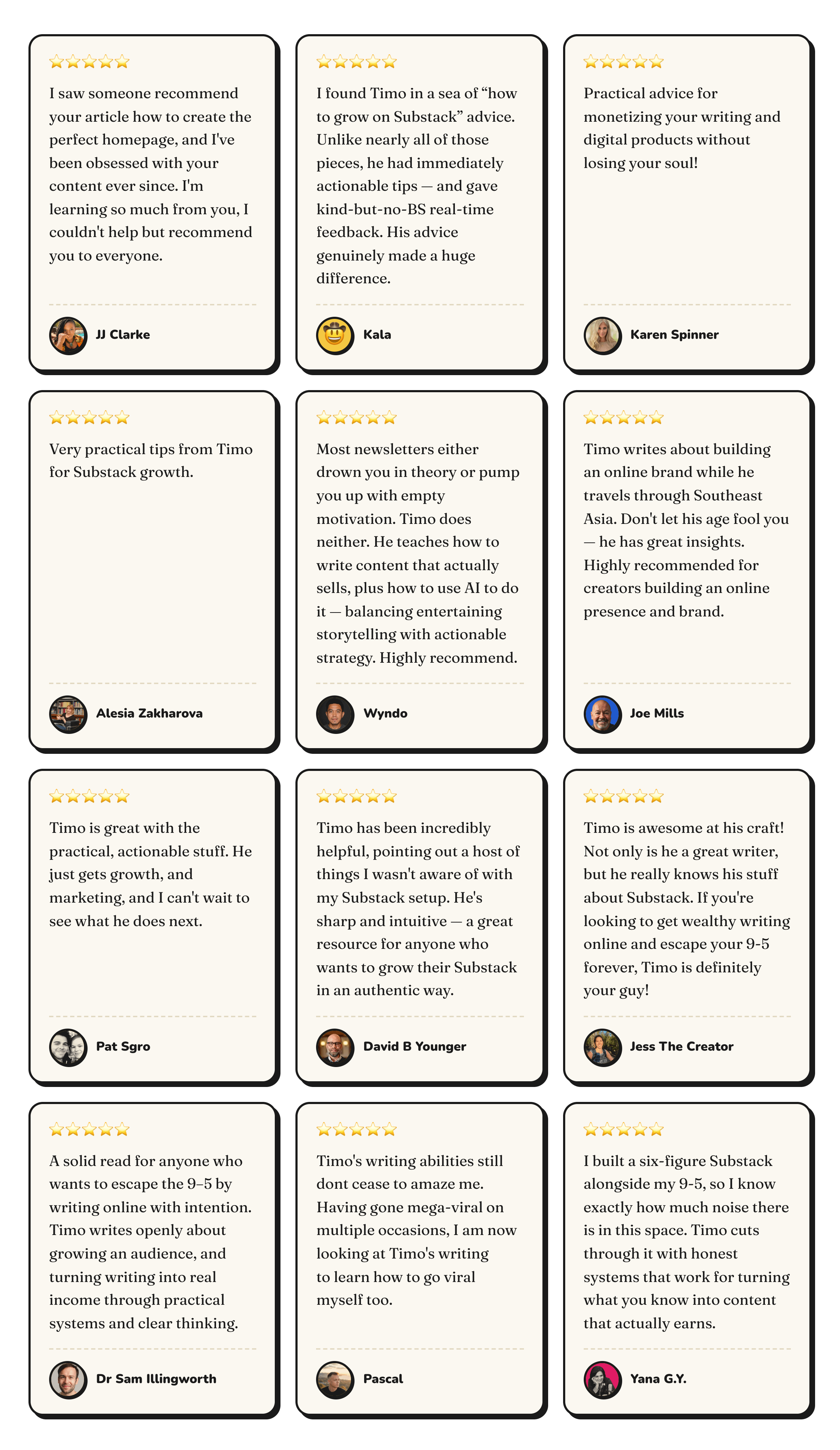
92. Turn scattered testimonials into one reusable visual asset instead of leaving them buried in comments.
I dumped my testimonials into a Notion database, handed Claude Design the link, and reused the resulting graphic on both my Start Here page and my welcome mail.
93. A custom branded divider is worth the one-time setup.
I had Claude Design create mine, then saved it as a one-click template so I never have to hunt through my files to manually re-insert the image into every article👇
To dive deeper into designs that bring you subs, check out the full & free Claude Design Substack guide here.
The Consistency Systems That Kept Me on Track
94. A viral moment doesn't decide your future. Showing up after it does.
One spike changes nothing if you stop again once it fades.
95. Most people quit right before compounding kicks in.
The flat, unrewarding early stretch is normal, not proof the approach failed.
96. When consistency feels impossible, check for misalignment before blaming laziness.
A format or niche you don’t deeply enjoy will drain motivation no matter how disciplined you are.
97. A content system is what carries you on zero-motivation days.
It's not a nice-to-have. it's what keeps you moving when willpower runs out.
98. Substack's native scheduler falls apart once you're managing more than an article every couple of weeks.
It can't plan ideas, show a visual calendar, or support real-time collaboration, so your content ends up scattered across Substack, Google Docs, and your notes app.
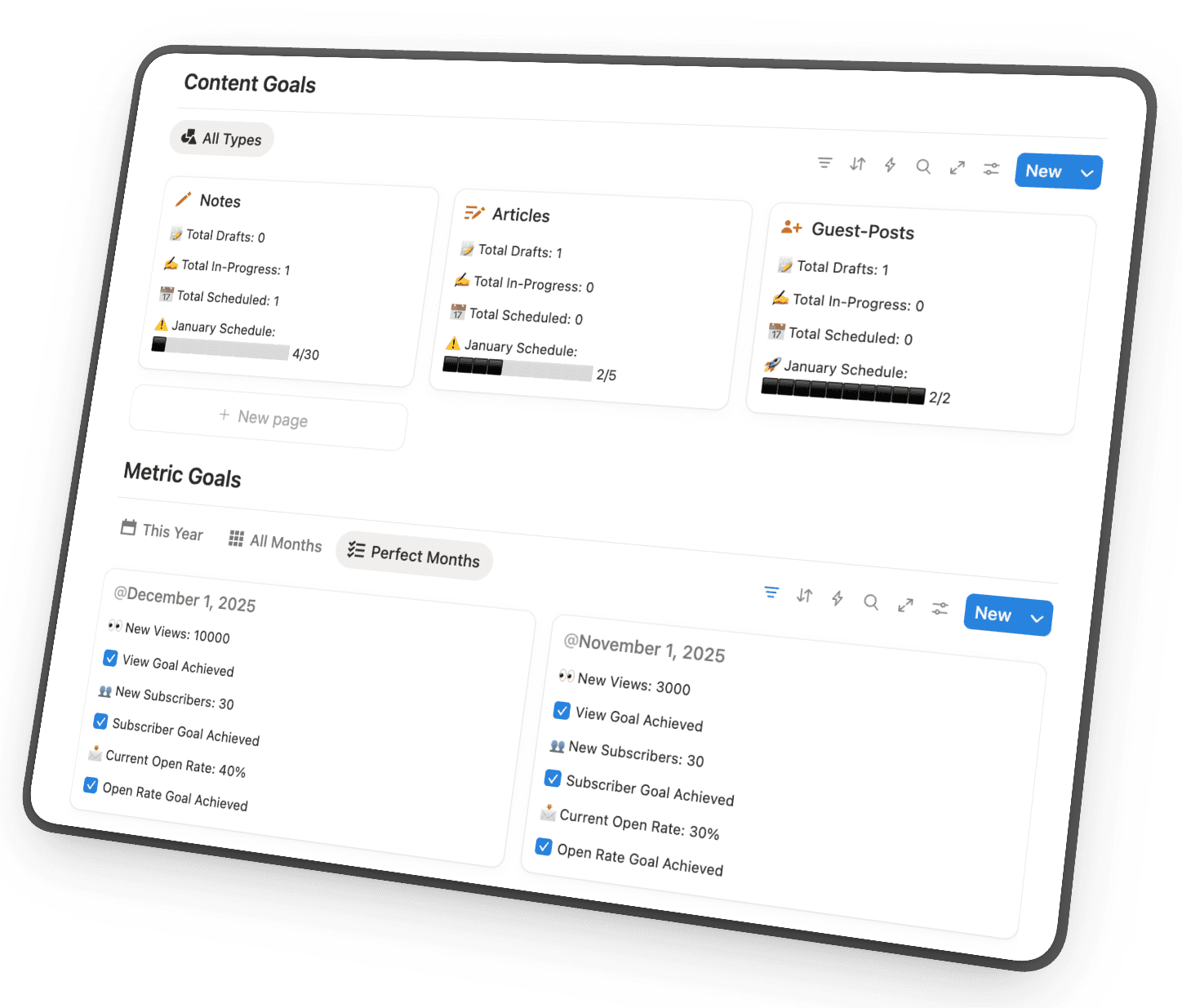
99. A Goal Center keeps your monthly targets in view.
So they don’t quietly slip while you’re heads-down on daily content.
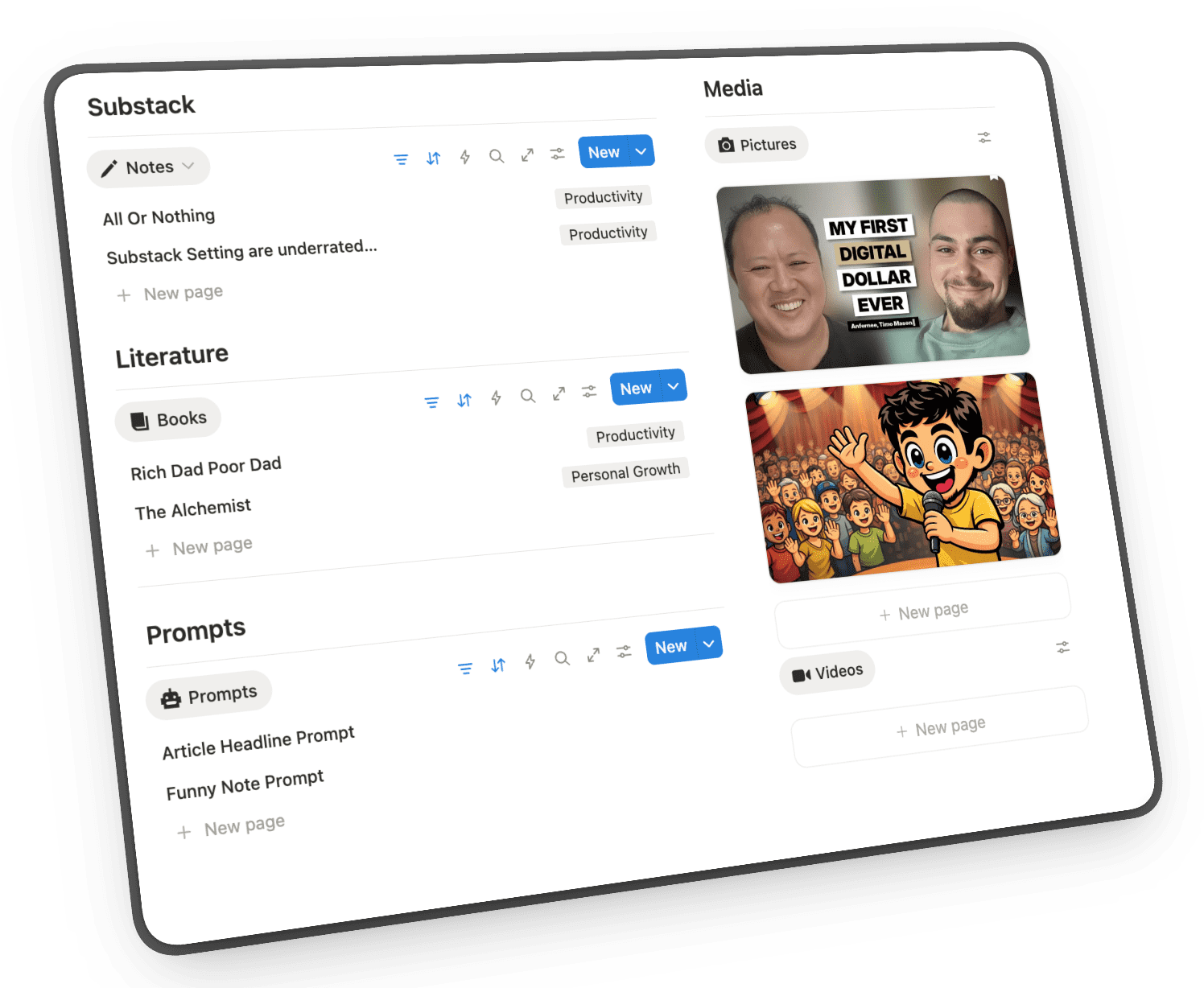
100. An Inspiration Library holds your ideas and prompts.
Random ideas get parked here the moment they hit you, instead of getting lost in a notes app you never reopen.
101. A Writing Room splits your work by content type.
Keeping formats separate means a half-finished article never gets buried under a pile of Notes drafts.
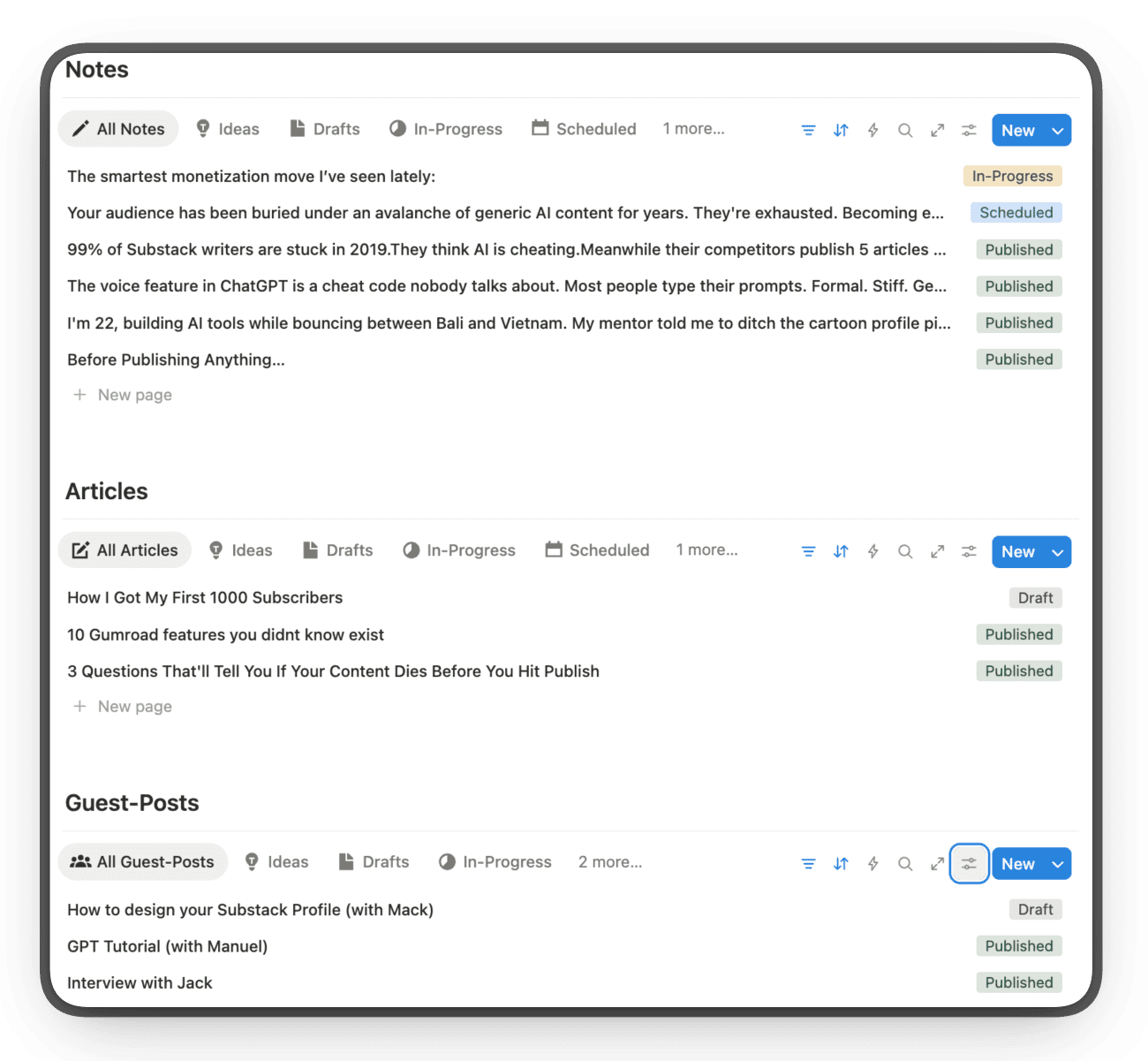
102. A Content Calendar shows you the whole month at a glance.
It’s what turns “I’ll try to post this week” into “I’m scheduled through next month,” once your whole content system is actually running instead of living in your head.
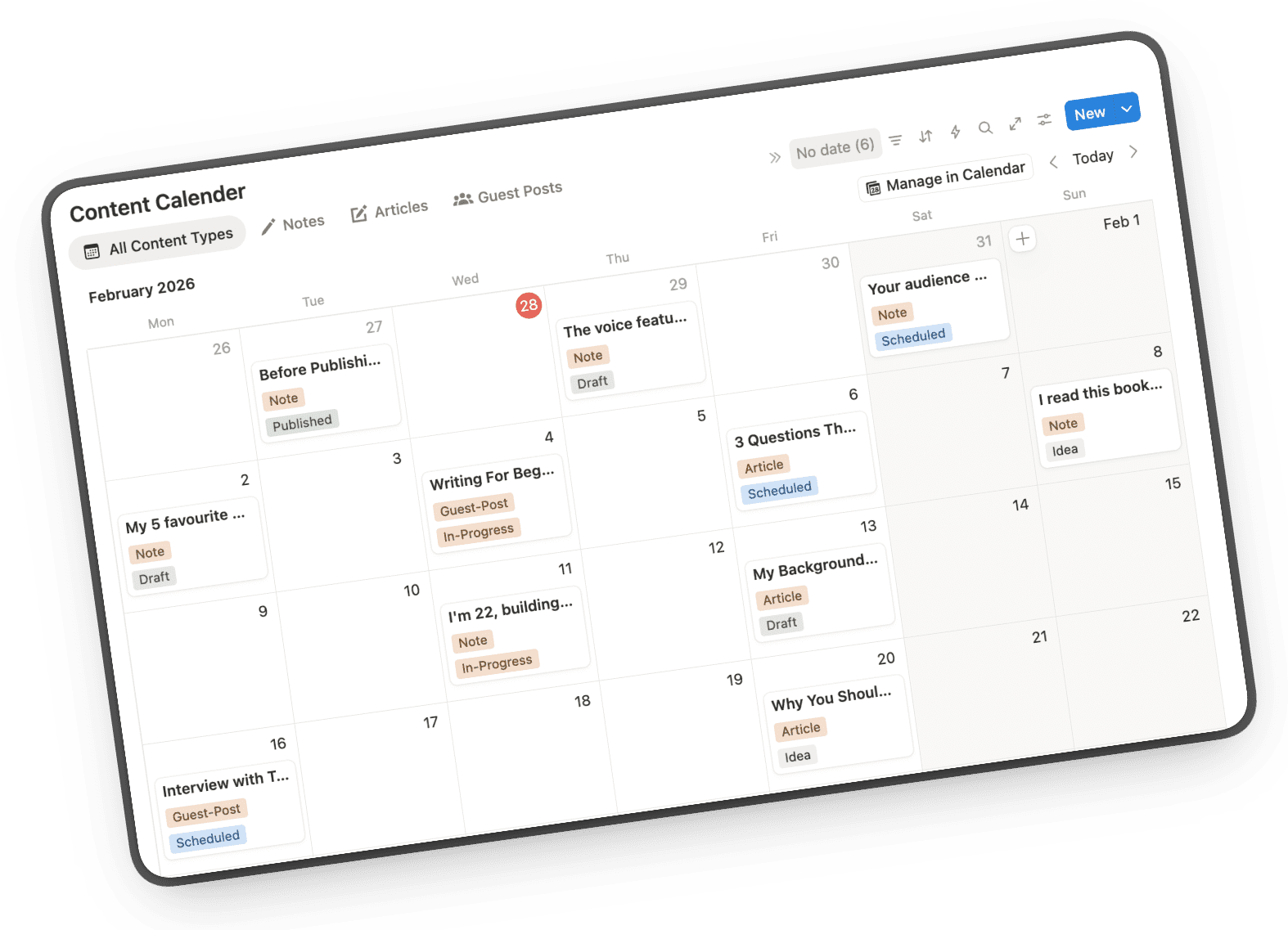
103. I built my own content system, Substack HQ, around what actually got me to 1,000 subscribers.
It's what let me publish two articles a week plus daily notes while traveling through Southeast Asia, running the operation instead of relying on raw willpower.
104. Check your subscriber-source data monthly and turn it into one decision.
My process: screenshot the new-subscribers dashboard once a month, feed it plus last month's to an AI with a prompt asking what changed and what to prioritize for the next 30 days, then act on the one decision that comes out.
105. Treat your publication like an ongoing conversation.
Each post should do a little of the next post's work instead of starting the growth conversation over from zero every week.
106. Build your business structure around who you actually are, not around a mentor's personality.
If my coach had stayed, I'd have spent a year running someone else's system, built around someone else's strengths, instead of my own.
107. Batch a full week's Notes in one sitting instead of scrambling for something to post several times a day.
Decide once, schedule the batch, then move on with your life.
108. Build your work schedule around three energy-matched blocks instead of trying to force one long ideal workday.
During three months of military reserve training with zero control over my hours, I ran my business on a 30-minute admin block during morning coffee, a one-hour deep-work writing block during midday break, and coaching calls after duty ended when my energy was too fried for anything else.
Subscribe now for weekly value bombs + FREE access to the 5-Day Substack Side-Hustle Sprint
How I Learned to Write (With AI)
109. Ask what exact problem you’re solving before you write anything.
That’s the one question that decides whether the piece has a reason to exist before you write a single word.
110. Ask whether the reader would recognize themselves in the struggle you’re describing.
If they wouldn’t see themselves in it, the piece reads as advice instead of something that actually lands.
111. Ask if your own experience gives you something to say nobody else can say the same way.
Without a genuinely personal angle, you’re just repeating what’s already been said better elsewhere.
112. You don’t need to reinvent the wheel of successful article formats
I didn’t invent this format of “X lessons from 1 year of Y” I saw the post “200 Lessons From 2 Years on Substack” from Sinem Günel, Philip Hofmacher & Jari Roomer and decided I would make my own version with my own lessons I gathered. :)
113. A first draft’s only job is to exist.
Use AI to kill the blank page fast, then spend your real effort editing it into your own voice.
114. Good editing is four separate passes, not one.
Structure/flow, clarity/formatting, personality, and the finisher each catch different problems.
115. If you don’t ask, people won’t act.
A post that ends without a clear next step gets read and immediately forgotten.
116. Two of my best-performing articles came from documenting a workflow I’d already built and tested, then writing about it after the fact.
“How Alex Hormozi Posts 250+ Times A Week“ came from a repurposing system I’d used for months; “How I Create Substack Articles 5x Faster“ came from an AI writing workflow I’d refined over weeks. Both beat generic how-to guides because they were my tested process, instead of theory.
117. Skip an article if it doesn’t fit your niche, no matter how solid it is.
I skipped writing about my own German tax-filing system, a solid workflow, but it has nothing to do with my niche.
118. Don’t write about a workflow until you’ve actually tested it on yourself.
The same stress-test I ran on my own Substack systems during three months of rigid military training is the same test any workflow needs to pass before you publish it as advice.
119. Check if a workflow can become a product before you write about it.
A name and a real thumbnail are what actually turn a workflow into something sellable, so it’s worth asking that question before you write the article, not after.
120. Your imperfections are proof you’re human.
As a non-native English speaker, I lean on Grammarly to catch mistakes, but I deliberately leave some in because they express who I am.
121. Your voice is your worldview made visible, not your vocabulary.
An AI plays it safe because it has no reputation to protect, and safety is what actually kills voice, not lack of polish.
122. Only about 10% of readers follow you for insights.
The other 90% follow you because they relate to your failures and honesty, and that connection is the one thing AI can’t fake.
123. AI can’t want anything.
It can’t crave approval or regret saying the wrong thing, and that inability to want is the one gap no machine can close, which is why an article about a failed launch gets more replies than a perfectly structured guide.
124. Writing beats video on speed, adaptability, and accessibility for a side-hustle schedule.
You can skim a 1,000-word article in three minutes and pull exactly what you need, while a 10-minute video forces you to scrub a timeline hoping someone added chapters.
125. Don’t let a platform’s algorithm shift talk you out of the format that fits your life.
Substack pushed video harder because it wants more time-on-platform for its own metrics, but the platform still makes most of its money from paid subscriptions driven by long-form writing.
126. Video is permanent in a way writing isn’t.
A typo in an article takes 30 seconds to fix; realizing you said the wrong stat in a video means reshooting the whole thing, living with the mistake, or bolting on an awkward correction.
127. AI can generate words, but it can't yet judge which words are wrong for this specific reader.
That judgment call is the actual skill left for a human to own.
128. Writing for the wrong awareness stage wastes good writing.
A "look how I overcame failure" story falls flat on someone who isn't in pain yet, no matter how well it's written.
129. AI is a shortcut to speed, not to success.
My first month writing online was pure ChatGPT copy-paste (15 articles in a month, about 30 views each, basically zero engagement) while people writing manually crushed me.
130. Don't skip the outline step.
Going straight from brain dump to full draft produces a mess disguised as a finished article. Review and adjust the outline until it could be your magnum opus before writing a single section.
131. Brain-dump out loud before you write anything.
I use ChatGPT's voice mode and rant like I'm venting to a friend. It gives AI raw, specific material (my real stories and opinions) it could never invent on its own.
132. The first AI-editing pass is cutting fluff.
Anything that doesn’t move the point forward gets deleted, even if it sounds nice.
133. The personality pass is where you inject your own voice into an AI draft.
My personality pass means adding my own slang, weird metaphors, and grammar “mistakes” that Grammarly keeps trying to correct.
134. The fact-checking pass is where a wrong number or misattributed quote gets caught before it goes out.
A single wrong number or misattributed quote is what actually breaks the trust an AI draft can’t earn back on its own.
135. AI only sounds human when you feed it something human.
Vague prompts produce robotic output. Personal experiences and real results create articles no AI could write.
136. Train AI on your voice before you generate a single draft.
I pull 5-10 of my best-performing posts, have AI analyze the patterns in them, and save that as a running "Voice Document" I paste into every new prompt.
137. Run everything through three questions before publishing.
1. Would I say this out loud to a friend, 2. Does it have one detail only I could write, 3. If I removed my name would anyone know it's mine. A "no" on any of them means I'm not done editing.
138. Reader trust doesn't wait for confirmation.
A study of 3,000 adults found trust dropped 50% the moment people merely suspected AI wrote something.
139. AI defaults to three-item lists and rigid "not X, but Y" formulas.
Once you notice the pattern in your own writing, it's a sign to break it.
140. Originality was never about creating from nothing.
It's remix plus intention, running what you consume through your own lens, and that's the one thing AI still can't do for you.
141. AI writes safe, generic hooks by default.
"AI is transforming content creation" stops no one, which makes the hook the one part of a post that most needs your own judgment, even when AI drafts everything else.
142. Untracked, repetitive ChatGPT prompting quietly burns about 25 hours a month.
Re-explaining your tone and context in every new chat, then editing mediocre output for 10 minutes, adds up fast.
143. Skip building a Custom GPT if you’ll only do the writing task once.
Building it costs more time upfront than just doing the one-off writing task yourself.
144. Never automate anything that needs real human judgment or relationships.
Some things are worth doing slowly and personally, not on autopilot.
145. Don’t automate a task you genuinely enjoy doing.
Only build a GPT for repetitive writing tasks that actually drain you.
146. Organize a growing library of Custom GPTs before it becomes unusable.
Past roughly 21 GPTs, ChatGPT's sidebar turns into a scroll-and-guess mess. I track each one's name, category, direct link, and knowledge-base link in a Notion database for instant access.
147. Volume only works if every single piece still holds a hook and structure.
I repurposed one article into 20 standalone notes, that all work without having to read the full long-form piece.
148. Success with one AI tool doesn't prove it's the best tool for everything.
I built my entire X content system around ChatGPT and hit 14 million views with it, which made me assume it was the right tool for everything, until I finally tested Claude for my long-form writing on Substack and realized I'd been leaving quality on the table the whole time.
149. Match each AI to the format it's actually built for instead of picking one tool for everything.
In my system, Claude handles all my long-form writing (articles, mails) because it writes in a way that flows, while ChatGPT handles my short-form writing (Notes, hooks, headlines) because it gets straight to the point without over-explaining.
150. Run your own 10-minute AI comparison before committing to a workflow.
Pick a workflow you already use, duplicate it identically in both AIs (a Custom GPT vs. a Claude Project with the same instructions and files), run the same input through both, compare the raw outputs side-by-side, then commit to whichever wins for that specific content type.
151. Token limits can kill your momentum mid-project, so build a backup into your system.
Switching my long-form writing fully to Claude meant occasionally hitting usage caps mid-flow, which is why I kept ChatGPT around for lighter tasks like analysis and brainstorming instead of letting momentum die.
152. Strip your argument of borrowed authority to see if it actually holds up.
Running my Hormozi article through a prompt that removed every appeal to expertise or reputation told me whether my logic could stand on its own. Only once it survived on logic alone did I add credibility back in, as reinforcement instead of a crutch.
153. Diagnose which failure mode your AI output has before you try to fix it.
Generic output, predictable structure, and flat tone each need a different fix (language constraints, structural paradoxes, or tonal pressure), so random constraints just make things weirder, not better.
154. Automate the article tasks outside of writing too
I built two custom Claude Skills. One that scans my own Notion article database and finds internal-linking spots in 30 seconds instead of the 20-30 minutes it used to take, and another that finds natural product-CTA spots and auto-generates the tracking link.
155. Structure your best insights as an “Answer Capsule.”
A question-based heading followed by a direct 50-80 word answer, no preamble. AI models cite you roughly 3x more often while you also win Google’s featured snippets.
156. Track which article sends which sale, not just how many articles you publish.
Once I could see that Article A drove sales and Article B didn't, I started writing more of what actually converts. That's the difference between publishing content and building a business.
157. Plug your Target Persona straight into your AI writing setup instead of just filing it away.
I add mine to the knowledge base of my Article Architect so every draft automatically writes to that one specific reader.
158. AI shouldn't decide what you write. That's still 100% your job.
I never use AI for ideation; I already walk into my writing setup with the idea locked in, because outsourcing the "what" to AI is where most creators go generic.
159. Screen recordings are the easiest faceless format to start adding to your articles
Karen Spinner walked her followers through setting up Google Analytics for Substack with no face and just narration, and it became one of her best-performing posts, using free tools like Loom, Screen Studio, or OBS.
160. Illustration videos let you tell a story through motion instead of explaining it out loud.
They create instant differentiation and work best if you already sketch ideas or think in metaphors.
161. Visual essays and slideshows pace a reader through a complex idea instead of dumping everything into text at once.
They fit best when your writing already has structure and you tend to think in frameworks.
162. AI-generated B-roll turns a script into video without filming anything yourself.
It fits best if you value consistency over spontaneity and want a repeatable workflow.
163. Master one writing format before multiplying across five.
Spreading thin across every platform at once is a trap, not a growth strategy.
164. The “Leave A Comment” button is the easiest one-click way to boost your comment count.
Dropping it directly into the article as a visible CTA instead of hoping people scroll down and find the comment section on their own drastically increases how many people actually leave one👇
165. Add the Share button fresh to every single article instead of copy-pasting it from an old post.
A copy-pasted Share button still points at the old post, so anyone who clicks it shares that old article instead of the one you’re actually writing right now👇
166. Substack keeps an old version of your article saved in the lower left corner, for when you fuck something up.
If you break formatting or delete something by accident mid-edit, that saved version is your way back instead of rebuilding the whole article from memory.
167. Add a Picture Gallery when one image can’t carry the point on its own.
It lets you show multiple images side by side inside the article itself, instead of forcing readers to scroll through a string of single images one at a time.
168. Use the “Send a DM” button instead of asking readers to reply by mail.
My mail inbox is way messier than my DMs, so I always direct people to message me there instead, cause that’s where I can actually manage and reply to them properly👇
169. Build an End CTA Template so you’re not rewriting your subscribe pitch at the bottom of every article.
Save your closing subscribe, block as a template once, then drop it into every future article instead of retyping it from scratch.
170. Add a Footnote for your sources instead of cluttering the body with citation links.
Substack’s footnote feature keeps your sources referenced and clickable without breaking up the flow of the actual article.
171. Use a Codeblock to deliver AI prompts inside your article.
It keeps the prompt in a clean, copy-paste-ready box instead of readers having to untangle it from regular paragraph text.
172. Audience-specific content is a better paywall than Substack’s actual paywall.
It lets you show one block to free readers and a different block to paid readers inside the same post, instead of cutting the whole article off and losing the free reader entirely.
173. Always fill out the SEO options and clean up the URL before you publish.
A clean, keyword-clear URL and filled-out SEO fields are what let search engines actually understand and rank your article, instead of leaving it invisible outside Substack itself.
Check out Article Architect. It's my AI writing system for outlining and writing Substack articles in minutes.
What I Learned About Eye-Catching Substack Headlines
174. Headlines decide everything.
If the headline doesn't land, it doesn't matter how good the rest of the post is, nobody gets far enough to find out.
175. A headline's only job is to open a curiosity gap.
Show the reader what they currently believe, then contrast it with what's true. The gap between the two is what pulls them in.
176. One headline, one idea.
Cramming three points into a headline dilutes all three.
177. A strong Substack headline first has to nail what it’s about.
Skip this and the reader has no idea what they’re even being offered.
178. A killer Substack headline also has to nail who it’s for.
This is what makes a stranger feel like the headline was written specifically for them.
179. A good Substack headline finally has to nail what problem it solves.
Without a clear problem → solution proposal, your headline has a hard time convincing readers the whole article is worth it.
180. Big numbers make a headline concrete instead of vague.
“How I Got 352 Subs From One Substack Feature 99% Of Creators Ignore” works because 352 and 99% are both numbers a reader can picture. The same headline without them just says “a feature nobody uses,” which convinces nobody.
181. Credible names lend a headline authority before the reader’s know what the article is about.
“How Alex Hormozi Posts 250+ Times A Week” pulls curiosity from a name people already trust, so the headline gets a running start it wouldn’t get from a nobody’s name.
182. Contradictions stop the scroll by fighting what the reader already believes.
“Guest Posts Convert Better Than Ads” only works because it pushes against the assumption that paid always beats free. A reader has to click just to check if that’s actually true.
183. Calling out the exact reader makes a headline feel personally addressed.
“The 1 Mistake That Stops 9-5 Side-Hustlers From Building Their Substack biz” names the reader’s exact situation directly in the headline, so anyone running a newsletter reads it as written for them specifically, not for creators in general.
184. A narrow topic-within-a-topic feels like a secret instead of a rehash.
“How The Paywall Works on Substack (And When to Use It)” isn’t about Substack growth broadly, it’s about one specific feature, narrow enough that it reads as insider knowledge instead of the same growth advice again.
185. A specific “X number” promise sets a low barrier to entry.
“The 1 Mistake That’s Killing Your Substack Open Rates” leads with “The 1,” which tells the reader upfront this is one fixable thing, not a 10-step overhaul.
186. Success stories work because the reader can picture getting the same result.
“How I Create Substack Articles 5x Faster” reads as a result a reader can actually picture landing themselves, not a hypothetical or a theory.
187. Dollar signs make the stakes concrete instead of abstract.
“How A $7 Product Turned Into Over 8,000 Sales” works because a reader can do the math themselves in two seconds, which a vague “how I built a profitable product” headline never lets them do.
188. Timeliness makes a headline feel urgent instead of evergreen.
“3 Substack Features Nobody’s Talking About In 2026” borrows urgency from the calendar. The same headline without the year reads like it could’ve been written anytime, which makes it easy to skip.
189. Question/answer headlines pull the reader in by making them want to check their own assumption.
“Why Do 95% Of Creators Miss This One Substack Setting?” works because it plants a specific number in the reader’s head and dares them to find out if they’re one of the 95%.
190. Substack's built-in title A/B testing feature settles headline debates instead of you guessing.
Write up to 4 headlines, let Substack test which gets the best open rate, and it auto-sends the winner to the rest of your list.
191. Your headline and your SEO title don't have to be the same thing.
My headline "How I Got 352 Subs From One Substack Feature 99% Of Creators Ignore" wins the inbox on curiosity but tells a search engine nothing, so I set a separate SEO title ("Substack Recommendations: How To Get More Subscribers") that stays clear for search while the headline stays built for opens.
Want the full Substack headline breakdown? Read it here.
What Actually Drove My Free Subscriber Growth
192. Early on, your own posts won't reach far. Borrow the audience that already exists.
Smart replies to bigger accounts became my free distribution channel before I had any audience of my own.
193. The fastest way past the "nobody knows me yet" phase is dropping pure value inside other people's communities with zero pitch.
One creator who posted free tutorials in a tool's Discord got that tool's own 1.5-million-follower founder to personally share his work, turning into a recurring course business.
194. Check your dashboard's Growth → Source → Notes view instead of guessing which Notes bring subscribers.
It sorts every Note you've posted by actual subscriber pull, so you can repost the winners and stop wasting time on what flopped.
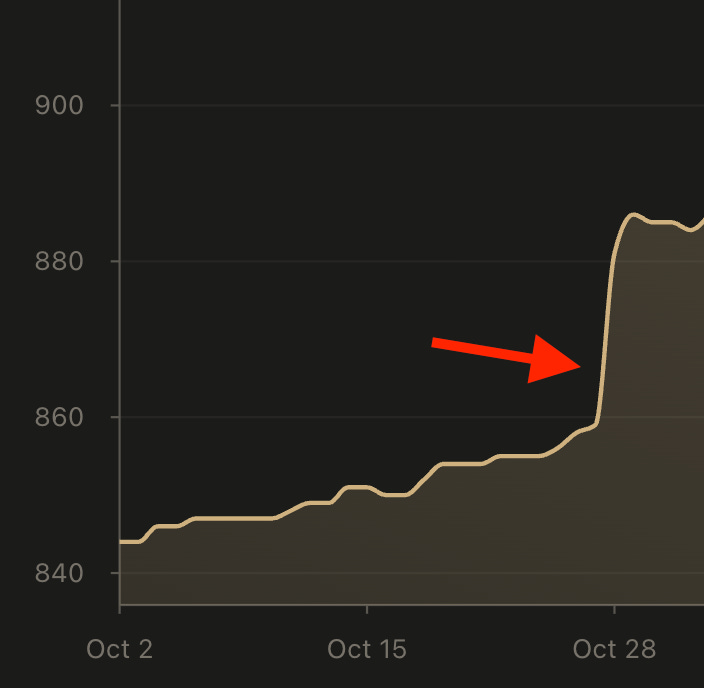
195. A single guest post can outperform months of your own organic growth.
When I wrote a guest post for Wyndo's newsletter, my subscriber count spiked harder in one day than anything I'd done on my own channel. Wyndo got a valuable article for his audience with almost 0 work, I got instant access his whole readership.
196. Your subscriber count gets you noticed, but your actual writing gets you approved for a collab post.
A potential collaborator clicks through and reads before saying yes to a guest post. 200 subscribers with sharp posts beats 2,000 subscribers with mediocre ones.
197. Landing collabs is a volume game, not a perfection game.
Pitch 10 creators, expect 3-5 to respond and 1-2 to say yes. if they decline you're exactly where you started, so there's no real downside to asking.
198. Filter collaborations by whether your readers share the same core problem, not by the size of the other person’s list.
A collab that’s off-thesis brings in subscribers who churn the moment your regular content doesn’t match what pulled them in.
199. Do more than 1 collab post if you vibe with a creator
Me and Vinayak Ramesh have created 3 collab posts over the year, because everytime we work together we cook up something neither of us could have done by themselves.
200. Notes don't convert readers, they discover you.
Someone sees a Note, clicks the profile, reads an article, and only then subscribes. Notes are top-of-funnel awareness, articles are the actual conversion tool.
201. Know exactly where your subscribers come from before you optimize anything.
Breaking down my 89 January subscribers by source showed Recommendations at 23, Notes at 11, Reader Discovery at 9, and Article CTAs at only 4.
202. More notes isn't automatically better
I once posted 75 notes in a single week to test it against my normal pace of about 20, and the high-volume week didn't bring in more subscribers, just more effort for the same result.
203. Sometimes the simplest note outperforms the clever one.
My best-converting note in January wasn't a crafted hook. It was just the article itself with no hook or CTA, with a matching thumbnail and title doing the rest of the work.
204. Articles that don't convert directly are still doing the heavy lifting.
Only 4 of my January subscribers came straight from an article's subscribe button, but articles are what validate my expertise and give my Notes something to stand on.
205. A viral moment can feel like proof you've made it, but it converts into surprisingly little.
You can have a viral note with thousands of likes but 2 weeks later nobody will care.
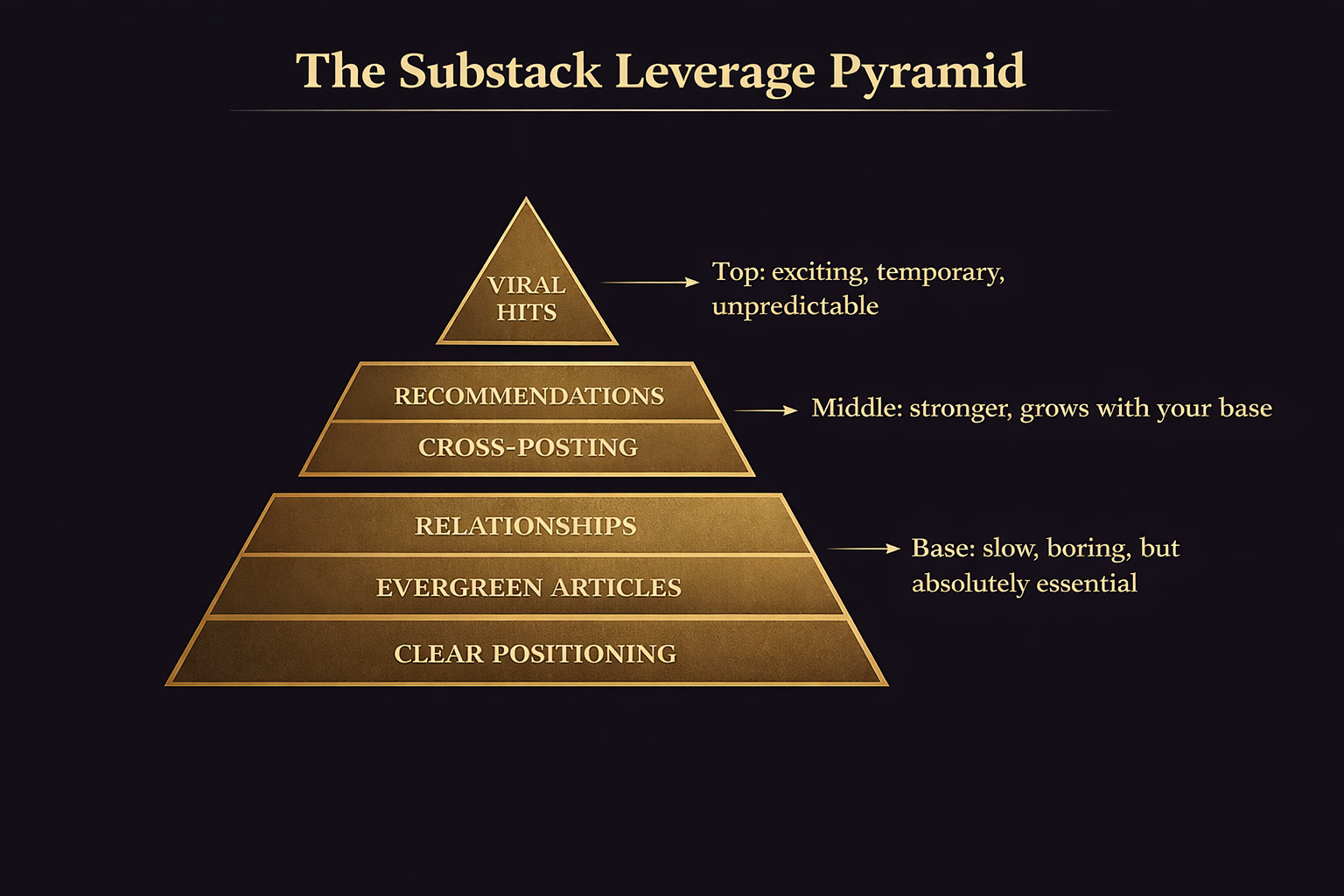
206. There's a Substack Leverage Pyramid, and most beginners build it upside down.
The base (clear positioning, evergreen articles, real relationships) is unglamorous but makes everything above it work; the middle (recommendations, collabs) compounds naturally once the base is solid; the top (viral notes, trending hooks) is high-excitement but empty without the layers underneath.
207. Evergreen articles compound, timely content expires.
"How to write a Substack welcome mail that converts" keeps pulling in readers two years from now, while a hot take on a new feature from three months ago is already dead.
208. Follower counts means nothing compared to free subscribers
I had over 4,000 Twitter followers, but most never saw my content because they lived on the algorithmic For You page instead of Following. Exactly why I shifted toward an owned mail list on Substack.
209. Substack's subscribe flow beats a multi-step funnel by design.
Getting a mail subscriber on Twitter meant a giveaway comment, a DM, a landing page, and a confirmation mail. On Substack, someone just hits subscribe.
Subscribe now for weekly value bombs like this one + FREE access to the 5-Day Substack Side-Hustle Sprint
How Recommendations Became My No.1 Growth Source
210. Recommendations put you in front of already-warmed-up discovery-mode visitors for free.
When a visitor subscribes to any publication, Substack shows them that publication's recommendations right after they hit subscribe.
211. If you’re not actively asking other creators for recommendations, you’re leaving growth on the table.
Recommendations were my single biggest subscriber source in January.
212. Trade recommendations directly instead of waiting for the relationship to happen first.
I deliberately disagree with the popular "build the relationship first, then ask" advice. A mutual recommendation swap is itself the fastest way to start a real relationship, because you're already winning together instead of just talking.
213. Audit your outgoing recommendations on a fixed cadence, not just once.
Check whether everyone you recommend actually recommends you back; if a direct ask gets no reply after 3 days, remove them. A one-directional recommendation is a slot that could go to someone who actually supports you back.
214. Multiply your recommendation-partner list by studying who already recommends people like you.
Add "/recommendations" to the URL of any aligned creator you've already found, and you get their entire outgoing recommendation list. A built-in shortcut to more people likely open to a swap.
215. Clean up your own profile before sending a single recommendation DM.
The first thing any creator does after your outreach message lands is check your profile, so an unpolished one silently tanks your outreach-to-recommendation conversion rate.
216. Treat recommendations as a compounding, not overnight, channel.
Sending just 20 DMs a week adds up to 240 creators contacted after twelve weeks, building a recommendation network that keeps feeding subscribers long after you stop actively reaching out.
217. Substack's Creator Match feature only shows you partners with genuine mutual opportunity, not just anyone big.
It's found under Creator Tools in your dashboard, rates matches three to five stars (nothing lower ever surfaces), and shows the estimated subscriber gain for both sides before you reach out.
218. A high match score doesn't tell you if that audience actually engages. Check that yourself before reaching out.
Creator Match ranks by subscriber count and overlap alone, so a big but sleepy list can be worth less than a smaller, more engaged one; spend two minutes on their Substack first to see if people actually comment and reply.
You find the full Substack Recommendations masterclass right here! :D
How I Made Real Substack Friendships
219. The readers who always comment and share are your foundation.
I engage them personally because they compound harder than any algorithm push ever will.
220. Substack’s Suggestions tab is a free channel for finding creators to network with.
It surfaces creators Substack already thinks are relevant to you.
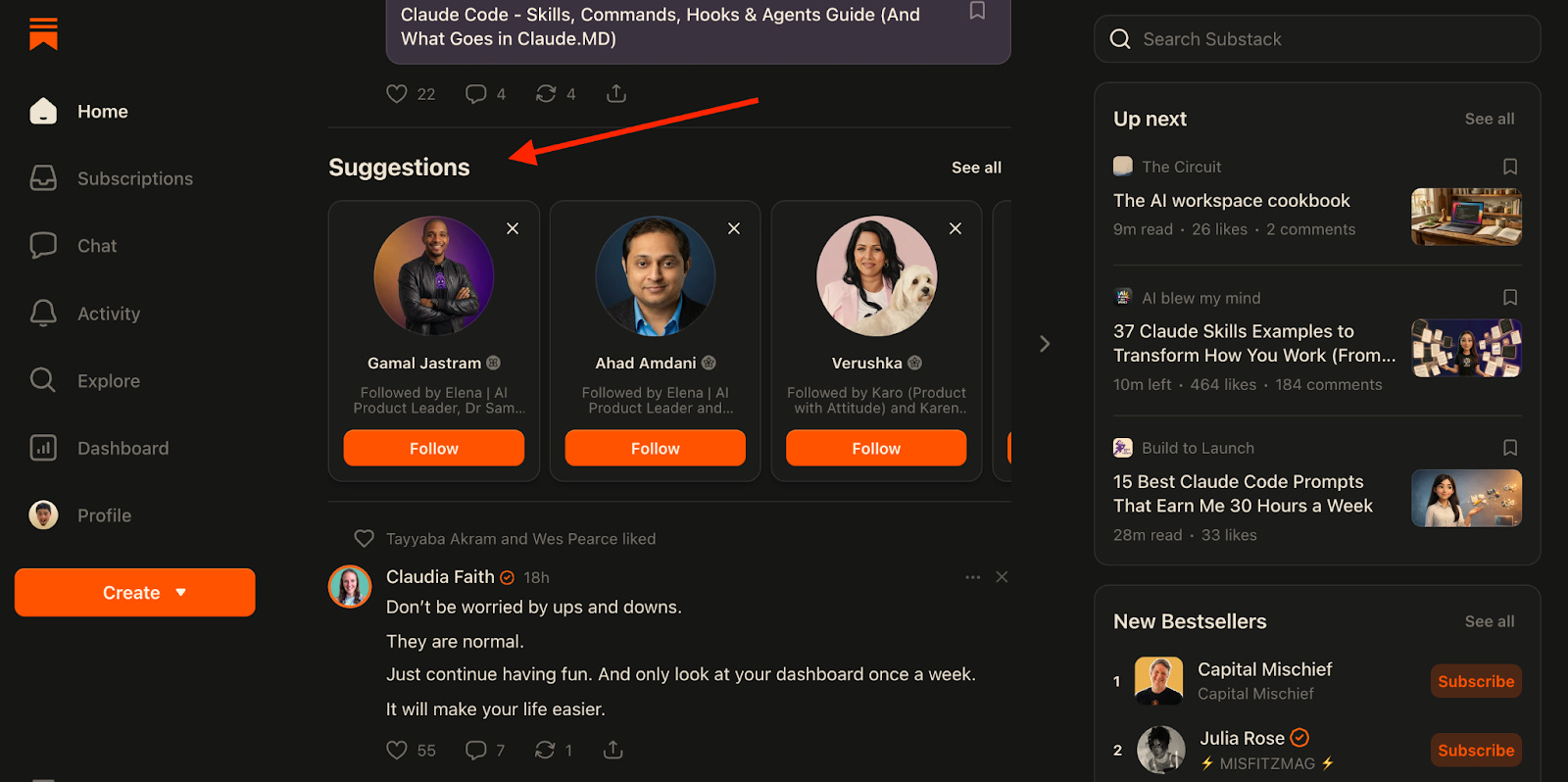
221. Watching who the creators you already follow collaborate with surfaces new people worth reaching out to.
Every collab a creator you already follow takes on is a free lead into someone new worth knowing.
222. Curation newsletters work around Substack’s weak search for finding new creators.
Projects like Cozora, from Claudia Faith, Joel Salinas & Michael Simmons bring visibility to a lot of amazing creators (in this example) in the AI niche.
223. Trade testimonials with other creators instead of waiting for them to show up.
Write a genuine testimonial for a creator I’m already recommending, send it to them, and ask if they’d ever want to do something similar for me. Most people are happy to return the favor.
224. Opportunities start in private messages
Deals, partnerships, and friendships all began with a simple "hey" I sent first.
225. Replying to every single comment is the highest-leverage habit on Substack.
It signals real engagement to the algorithm, which pushes your content further, and turns a warm reader into an actual relationship in one move.
226. DM every new subscriber in their first week, while the connection is still fresh.
A subscriber who you had a dm convo with is far more likely to stick around and eventually buy.
227. The Subscriber Chat works when you run it on structured, repeatable prompts.
Weekly rhythms like a "Finish Friday" or "Mission Monday" with a open question gives people a reason to show up on a schedule instead of a chat that goes quiet between random posts.
228. The Subscriber Chat works just as well as a simple, personal habit instead of a structured format.
Sharing each new article in chat with a short personal note about why you wrote it turns a content notification into something that reads like it's actually from a person.
229. A DM outreach that could've been copy-pasted to anyone gets ignored.
When sliding in the DMs of a fellow Substacker, reference something specific from their actual work. It proves you read it and opens a real conversation instead of a transaction.
230. Don't drop your own article links in other creators' comment sections.
It reads as spam rather than genuine engagement, and it quietly kills your reputation with both the creator and anyone else reading the thread.
231. Don't let AI handle your replies.
People can tell, and the moment they realize they "connected" with a bot instead of you, the trust they'd built up is gone for good.
232. Real relationship-building on Substack has no metric and doesn't show results tomorrow.
Reach out to creators you genuinely respect with a real message instead of a copy-paste collab pitch, and reply to people who comment instead of just hearting it. Even though it will not automatically increase your subscriber growth tomorrow.
233. Communicate scheduling uncertainty to clients directly instead of hiding it out of fear of looking unprofessional.
When I got put on reserve for a 5-day mission with no set end time, I told my coaching clients like David Roy the full situation straight instead of pretending everything was business as usual, and one honest message solved what could've become a mess.
Read the FREE Substack Networking Masterclass right… 👉here👈 :D
Fellow Substackers I Learned From
234. The GOAT of Gumroad comes straight from Singapore
Anfernee is the go-to when it comes to monetizing digital products on Gumroad, which is exactly why I built THE Gumroad Game Plan with him.
235. Design decisions on Substack are worth outsourcing to one specific person instead of guessing.
Pinkie from AI Meets Girlboss 🦩 is the sharpest creator I know on Substack design, which is why we collabed on the article about using Claude Design to pimp up your Substack.
236. AI advice for your business only helps if it’s actually practical.
James Presbitero is the rare creator who combines AI, depth, and practicality for business in one place, instead of picking just one of the three.
237. The best growth advice is the kind backed by numbers, not opinion.
Yana G.Y. is the most practical, number-based creator I know for growing a Substack, and when she has a clear opinion on what to do, it’s cause she ran the numbers, not cause she’s guessing.
238. Practical Substack tools that are actually worth the money are rarer than you’d think.
Finn Tropy is the guy behind StackContacts Press, StackContacts Connect, and a bunch of other tools that actually earn their price instead of overcharging like A LOT of other Substack tools out there. ;)
239. The most fun AI content doesn’t have to sacrifice depth to be entertaining.
Mia Kiraki 🎭’s pop culture references pull you into genuinely detailed AI essays, which makes her probably the most fun AI-based creator on Substack to read. :D
How I Built My Substack DM System
240. DMs get you the truth your public comments never will.
Comments skew positive and surface-level; asking directly what's confusing, unclear, or missing in your writing only happens in a private one-on-one.
241. Every coaching client I've gotten so far came through a DM conversation, not a pitch.
I built the relationship first through personal DMs and let selling become the natural next step only when it was genuinely the right fit.
242. Automate the sending, not the relationship.
I use a DM tool (StackContacts Connect from Finn Tropy) to auto-insert each subscriber's name and handle the sending, while keeping answers to their reply personal.
243. The DM message to a follower should nudge them toward subscribing, not sell them anything.
It’s a soft, single-question ask that turns a passive follower into an actual subscriber before the relationship goes any further.
244. The welcome DM to a new subscriber should sort them into a bucket based on their answer.
I include my 3 content buckets in my welcome page, and they answer me which one they are most interested in.
245. The third message routes each subscriber to the one article that matches their bucket.
Sending the specific piece that speaks to their actual interest does more for trust than pointing them at your whole archive.
246. The fourth message makes exactly one clear ask (a share, a testimonial, or feedback) never more than one at a time.
Stacking multiple asks into the same message makes it read like a favor list instead of a conversation.
247. A single 30-day check-in DM can resurrect subscribers who forgot they ever signed up.
Just asking "what's your biggest bottleneck right now?" a month in shows you actually care and reopens a conversation that would otherwise stay dormant forever.
My full Substack DM framework + the exact DM’s I send myself are what you find right here. :)
Tools I Learned To Use
248. Notion runs both my to-do list and my entire content system.
It's where I manage all my to-dos as well as my content management.
249. ThriveCart hosts my digital product pages and funnels.
It's the tool where I host the landing pages of my digital products and my funnels.
250. Claude handles everything writing-related.
It's the AI I use for almost everything.
251. ChatGPT is reserved for thumbnails and visuals.
I use it specifically for thumbnail creation and for most of my visuals.
252. Fathom beats every other meeting-recording tool I've tried.
I tried Notion AI before, which also does transcripts, but Fathom is definitely the best. I use it to go through transcripts and to send my coaching clients the recording so they can rewatch their calls.
253. Calendly handles booking for my free strategy call.
As part of my paid tier, I provide a free 30-minute strategy call, and I currently use Calendly so people can book it.
254. Kit runs the email automations Substack can't.
Every person who subscribes on Substack comes into my Kit system too, so I have them saved there and can mail them from there, running them through more complex automations than Substack itself would allow.
255. WhatsApp is how my coaching clients reach me directly.
Every coaching client gets my WhatsApp number so they can talk to me directly.
256. StackContacts Connect sends my welcome DMs.
I use it to send welcome DMs to new followers, new subscribers, and new paid subscribers.
257. StackContacts Press publishes straight from Claude.
I use it to create articles directly from Claude, and to create and schedule Notes from Claude too.
258. Handy is my free alternative to Wispr Flow.
It works amazingly well, and there's no subscription to pay for it.
259. Google Meet runs my strategy and coaching calls.
It's my preferred tool for the 30-minute strategy calls and all the coaching calls I do.
How I Made 100’s of Digital Product Sales
260. Link clicks predict a purchase far better than opens or likes do.
An analysis of tens of thousands of Substack events found roughly 89% of buyers had clicked a link first, versus about 16% of non-buyers.
261. A product collab only makes sense if it doubles the value you deliver, not just splits the workload.
Halving your revenue only pays off if the partnership genuinely produces more than either of you could alone.
262. Be generous with affiliate commission.
I pay 50% on pretty much everything. Without the affiliate I’d make zero dollars from that sale anyway, so splitting it isn’t a favor, it’s a real partnership.
263. Turn your beta testers into your first affiliates.
Invite 10-20 people to test a new product free in exchange for feedback and a testimonial, then offer them an affiliate link right after they submit it, since they already know the product works.
264. Get product-market fit solid before you recruit affiliates.
Sending people to a broken funnel damages your relationship with them, no matter how good the affiliate split is.
265. Your value is measured by the transformation you deliver.
Shifting from "content creator who posts" to "expert who solves problems" is what opens the door to premium pricing.
266. Structure your content calendar as three weeks of pure value, one week that spotlights your paid offer.
Your audience never feels constantly sold to, but you keep reminding them you have something to buy.
267. Charging even $1-10 for something you were going to give away free filters tire-kickers from buyers.
Free lead magnets tend to attract people with close to zero lifetime value.
268. Sell outcomes, not features.
"The exact system that grew my list from 0 to 1,000 in 90 days" converts better than "comprehensive guide to building an audience" because specific promises beat vague ones.
269. You don't need to create new content to build your first product.
Every article you've already published is a lesson inside a product that doesn't exist yet. I packaged my own articles into the free Substack Side-Hustle Sprint, and the exact same content could just as easily have been sold for $27-47.
270. Start with the person, not the product.
Before I touched a single article, I got specific about exactly who the Sprint was for. Someone with a 9-5, limited time and energy, just starting a Substack side hustle. Because once you know exactly who you're building for, every decision after that becomes obvious.
271. Reverse engineer your course from what your reader actually needs, not from what you've already written.
I mapped out the 5 things a total beginner needed to know first, then went looking for which pieces I'd already written (two of five slotted right in). The three gaps became my next three articles, published normally first, then pulled into the course.
272. A missing piece of your course is your next content slot.
Write it as a standalone article, publish it to deliver value on its own, and it does double duty. First as a normal post, then as a module.
273. Pick your packaging format based on where you actually are.
A single Notion page with clear sections is enough if you're starting out, while a mail sequence tool like ConvertKit turns it into an automated, hands-off product once you're ready to upgrade.
Read “How I Turn Articles Into Money-Making Courses” for the full breakdown
274. Master a workflow for yourself before you ever think about selling it.
I built my long-form writing prompt by tweaking it after every article I published, with zero plan to turn it into a product. It only became one once it stopped feeling like work.
275. The signal that a workflow is ready to sell is whether it would save someone else time or energy
I didn't wait for my writing prompt to be "finished". The moment it noticeably sped me up, I started packaging it.
276. A name and a real thumbnail turn a prompt into a product.
I called mine the Article Architect instead of "my internal writing prompt," made a proper cover image, and priced it low ($7) as an entry point rather than a flagship offer.
277. When your own workflow evolves, update the product to match and tell the people who already bought it.
When I moved my personal writing process from ChatGPT to Claude, I added the raw prompt to the delivery mail so buyers could use it anywhere, and mailed every past customer to let them know, instead of quietly updating it for new buyers only.
278. Bundle single small products together once you have a few in the same niche, instead of selling them one by one forever.
I combined three separate $7 GPTs into one bundle that converts better and charges more, for almost zero extra work to create.
Read the deep dive in“How I Turned a Simple Prompt Into $600”
279. Cap your client capacity on purpose instead of scaling for its own sake.
I stopped taking new 1:1 coaching clients once I had four running at the same time, choosing to give each person my full attention over adding a fifth.
280. Give your freebie one permanent link, and never touch it again.
Keep the actual resource behind a single stable URL (a Notion page, a PDF), so you can swap out the content behind it anytime without breaking anything you've already published or promoted.
281. Deliver your existing freebie to current subscribers using audience-specific content blocks, not a separate announcement post.
Substack's "Audience specific content" feature lets you show the freebie only to existing subscribers in one box, and a subscribe prompt to everyone else in another, inside the same post.
282. Put your freebie delivery on autopilot inside your welcome mail, once, and never think about it again.
Paste the freebie link straight into your automated welcome mail so every future subscriber gets it without you lifting a finger.
283. Never put your freebie's actual link in your bio.
People need to subscribe first. Promote the freebie in three visible places (a dedicated homepage promo page, your profile description, and your article CTAs) without ever leaking the content link itself.
284. A dedicated promo page for your freebie is the single highest-leverage page you can build once.
It's a "build once, get subscribers on autopilot" asset. I treat writing it as the highest-leverage action a creator can take from the whole freebie-promotion process.
285. Every completed problem creates the next one. Sell the solution to that, not something unrelated.
My own example: a free content-idea GPT solved the "no ideas" problem, which immediately created a new "now I have to write it" problem. So I put a paid content-writing tool directly in front of people right after, and it converted well.
286. Match your upsell's format to your freebie's format, not just its topic.
Someone who downloaded a GPT freebie is telling you they're comfortable working inside a chat tool with a prompt. Pitching them a totally different format (like a vibe-coded app) creates friction even if the underlying value is the same.
287. Make your product family's branding say "these belong together" out loud.
Related products need a shared naming structure and a visual identity that feels like the same family, or the connection feels off to a buyer even if they can't say exactly why.
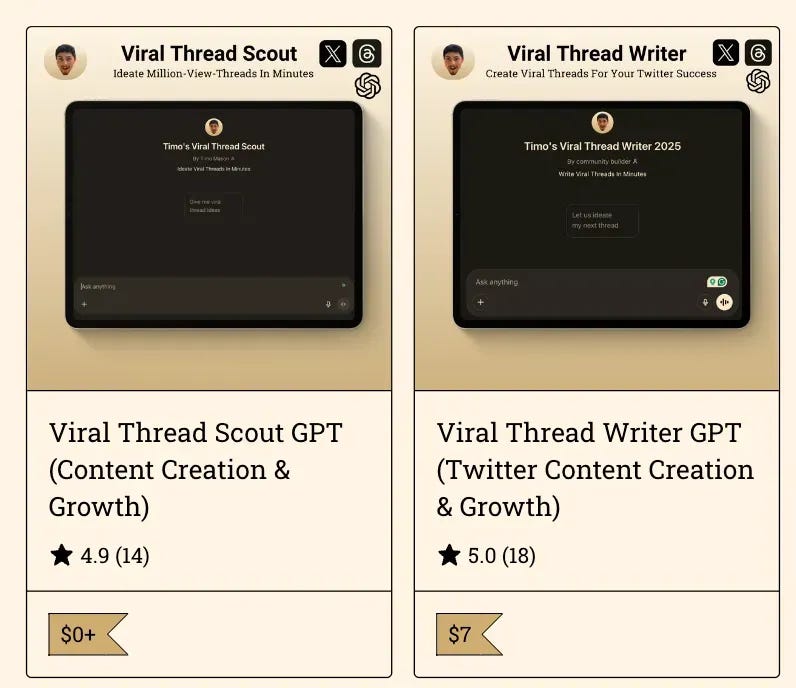
288. I price every first paid product in a funnel at $7, on purpose.
The goal of that first sale isn't getting rich, it's turning a reader into an actual customer. The real money comes from the upsell of the upsell, not the entry product itself.
289. The problem-solution loop doesn't stop after your first upsell. It's the same engine for every product after that.
Freebie to $7 product to $50 product and beyond, each one solving the specific new problem the last one just created.
290. A low conversion rate is a product problem, not a traffic problem, once your clicks are already warm.
My Substack HQ landing page converted at just 1% even though every click came from my own mail list, which ruled out "wrong audience" as the excuse.
291. Test exactly one variable at a time and wait a full 30 days before judging it.
My first fix (adding 50% subscriber discount) only moved me my conversion from 1% to 2%, so it was not the reason.
292. Don't assume a "best practice" fix applies to your specific audience.
Cutting a promo video for a clean thumbnail, didn't move my conversion rate at all, telling me the video was never the actual problem.
293. Price can be the lever the whole time, even when it's the change you least want to make.
Dropping the price to $25 took me from 2% to 8% conversion, which meant price was the “lever” the whole time.
294. A cheap front-end product's job is to open the door, not to make you rich.
I never expected to get wealthy off $12.50 sales. The real value is the relationship it opens, which leads to bigger offers afterward.
295. If people aren't buying, ask them why instead of guessing.
I added a single follow-up question "what stopped you from grabbing this today?" for everyone who clicked through without buying, and even a handful of honest replies told me more than any analytics dashboard could.
Read the full “How I 8X’d My Digital Product Conversion Rate With 3 Simple Fixes” to get the deep dive.
What I Learned Selling Through Gumroad
296. Optimizing your existing checkout beats chasing more traffic.
The top 1% of Gumroad creators take home about 60% of all money earned on the platform not because their products are better, but because 2,000 optimized clicks can out-earn 5,000 clicks to a broken checkout.
297. Turn off every setting that adds friction to checkout.
No discount field, no recommended products, no tipping. Since each one pulls a buyer’s attention away right before they’d otherwise complete the purchase.
298. A single bad review can be erased by revoking that buyer’s product access.
Gumroad removes the review the moment access is revoked, which I use on unfair or troll reviews to protect my product pages’ social proof.
299. Duplicate your best-performing product instead of building new ones from scratch.
I cut my product-launch time from 20 minutes to 5 this way, across more than 45 Gumroad products and 8,000+ sales.
300. Set every digital product to “no refunds allowed.”
Gumroad keeps its transaction fee even when a sale gets refunded, so a refund otherwise costs you the sale price and the fee both. I close that leak with a simple final-sale note on the product page.
301. Lock your currency to USD unless your entire audience lives in one country, and get it right before you publish.
My collaborator Anfernee learned this the hard way launching his first products in Singapore Dollars and fielding constant price-confusion questions until he switched.
302. Use "Versions" to run flash sales with real scarcity.
A version capped at a handful of purchases closes itself automatically once the slots are gone, so the urgency isn't fake.
303. Bundle a free lead magnet and your paid product as two versions of the same listing.
The free version pulls people in and the paid version is sitting right there waiting.
304. Enable your public sales count once you have meaningful traction.
Seeing that a few hundred people already bought something becomes social proof for the next visitor deciding whether to trust you.
305. Lead your Gumroad profile's home tab with your bestsellers.
Like a physical store, you put the best stuff in the window, not the back corner.
306. Keep every product thumbnail in the same visual style.
It's the single highest-leverage fix for a profile that looks like ten different people designed ten different products. Inconsistency signals chaos, and chaos doesn't convert.
307. Set a concrete threshold before upgrading off Gumroad, don't upgrade on a feeling.
My own rule of thumb: make your first $1,000 on Gumroad before even considering a move. The roughly 15% total cut is fine while you're starting out, but it adds up fast once you're doing real volume.
308. A cheaper platform isn't automatically the better one if the learning curve kills momentum.
I moved my own products to ThriveCart (a roughly $500 one-time fee instead of an ongoing percentage cut, just Stripe's ~2.5% fee) but still set up new coaching clients on Gumroad first, because ThriveCart isn't beginner-friendly and the fundamentals of selling are platform-independent anyway.
To go from zero-clue to Gumroad pro right THE Gumroad Gameplan. :)
The 308 Lesson Cheat Sheet
If you really want to absorb all the knowledge I gained in one year, it will take you more then just one 30-minute read-through.
So I created the 308-lesson cheat sheet where you can check off each lesson one-by-one and revisit them anytime, instead of trying to find this post in your already cramped inbox in 2 weeks. :)
Letter From Future-You Prompt
I want to give you a head start on where one year of building your Substack biz can take you, so I built a reflective prompt: tell it where you stand right now, and it hands you back a real picture of where you could be in one year.
From the outside, this year looks like a straight line of progress. It wasn’t.
Plenty of days I worked and it felt like nothing moved. Knowing where you could end up before you even get there is what carried me through those days, and it can be your North Star on the dark days too.
Paid subs see the Letter From Future-You Prompt here. Upgrade now for free to also get instant access.
You Made It! :D
Which lesson was the most valuable for you?
Drop the number of your favorite lesson in the comments, im curious. :)
A year ago, none of these lessons existed.
Not one of them. They only exist cause I sat down and worked on my business and my dreams every single day for a year, no excuses, just consistent action.
If you’re still sitting on the fence about your own Substack, or your own dream, this is your sign. Start today. One year from now, you’ll thank the version of you that finally did.
Subscribe now for weekly value bombs like the one you just read + FREE access to the 5-Day Substack Side-Hustle Sprint
See you next week, :)
Timo Mason🤠
A job feels safer because someone else is making the decision about your risk. You just don’t get to see it coming.
Walking away from 13M views to build here is the move most creators won't make. Views are rented, an email list is owned. The line I'd underline is keeping it running through three months of military training. A business that keeps selling while you're unreachable is the kind that's actually worth something, to you and to anyone who might one day want to buy it.