

That Viral Notes Advice You Keep Reading Is BS
Here's a better solution


Howdy, Wealth Writers🤠
You’ve seen the viral posts: “Here’s the Notes formula that got me 500 new subscribers in a week”.
Looks impressive, sounds simple, and gets reshared endlessly. So you try it, and it feels completely wrong while also getting zero results.
There’s a BIG difference between a Note that looks like it should work and one that actually brings in readers.
Rick Bettencourt from The Worthy Writer doesn’t chase viral.
He’s built a real audience by posting Notes consistently, sustainably, and without performing for an algorithm, and he will give you the full blueprint today. :)
What you’ll learn in this article:
✓ How to batch a full week of Notes in one sitting so you’re never scrambling
✓ What actually makes a Note create connection
✓ How to use AI for angles without losing your voice in the process
Let’s goo! 🤠

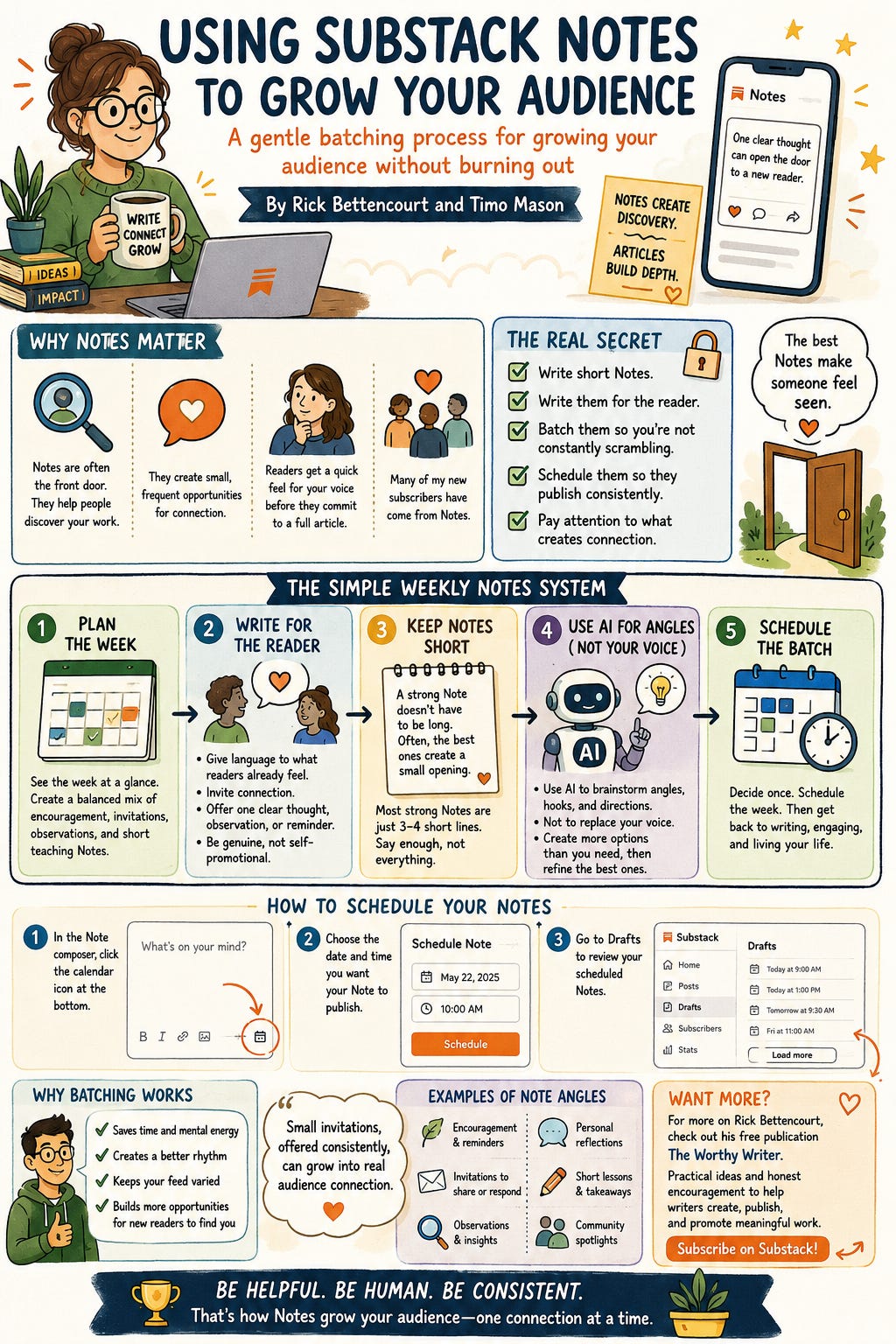
Substack Notes have become one of the simplest ways I’ve found to help new readers discover my work.
Notes are where a lot of discovery happens.
Articles matter. Articles are where people spend more time with your ideas. They are where you build depth, trust, and connection.
But Notes are often the front door. And this is why I spend so much time on them and want to share my approach with you.
They are how someone first notices you, gets a quick feel for your voice, and decides whether they want to read more.
For me, many of my new subscribers have come from Notes. They have been one of the clearest ways new readers have found my work.
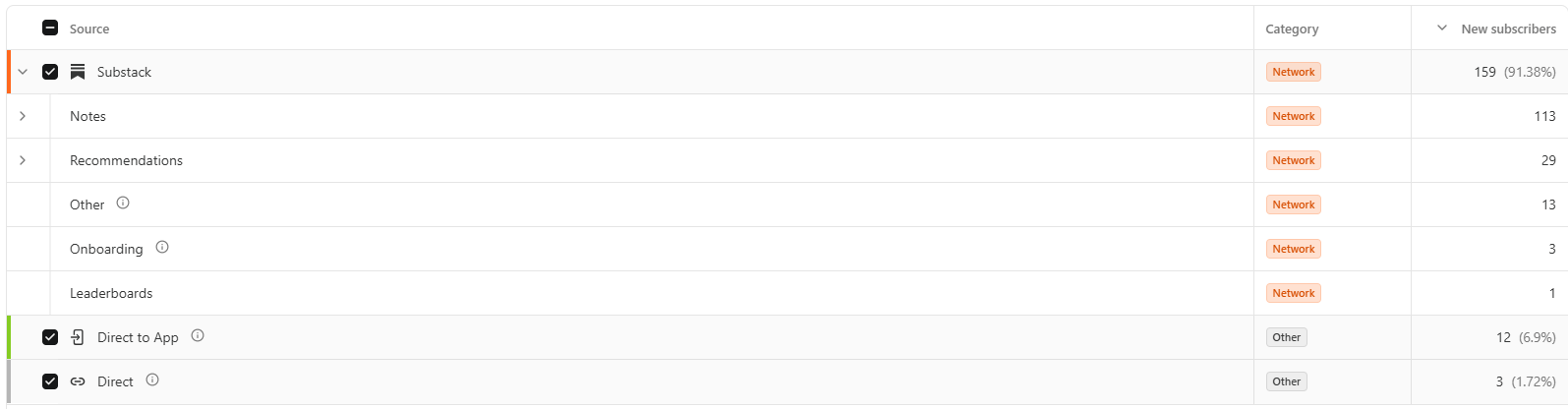
Notes have been one of my clearest subscriber discovery paths.
Substack Notes work because they create small, frequent opportunities for connection. They let people encounter your voice before they commit to reading a full article and give them a quick sense of whether your writing might be worth following.
Articles build depth.
Notes create discovery.
That distinction matters.
The challenge is that posting Notes throughout the day can become exhausting. Nobody wants to interrupt their writing life four or five times a day just to think of something useful or meaningful to say.
That is why I batch mine.
My approach is simple: I write several Substack Notes in one sitting, schedule them throughout the week, and let them work quietly in the background while I focus on writing, responding, and engaging with readers.
The Simple Weekly Notes System
My general goal is to publish four to five Notes per day.
That may sound like a lot if you imagine stopping several times a day to come up with something worth posting.
I don’t recommend that.
Instead, I create most of my Notes upfront.
I sit down once, come up with ideas for the week, draft several Notes at the same time, and then schedule them throughout the day.
The exact schedule matters less than the larger habit:
Create the Notes before you need them.
That one shift makes the process feel lighter. Instead of asking, “What should I post right now?” several times a day, you make the decision once. You create a batch. You schedule the Notes. Then you move on with your life.
For me, the goal is not to live on Substack.
The goal is to create enough small points of connection throughout the week that new readers have more opportunities to find me.
Before I schedule anything, I like to see the week at a glance. This helps me create a balanced mix of encouragement, invitations, observations, and short teaching Notes..
Write for the Reader
Once you decide to batch your Notes, the next question becomes obvious:
What am I going to write about?
For me, this starts with my audience.
Your Notes should connect to your genre, themes, message, and the kind of reader you want to attract. They should orbit the same world as your longer articles.
They do not all need to be mini-essays. In fact, the better ones are not.
A good Note is often just one clear thought, one observation, one invitation, one useful reminder, or one small moment that makes the right reader stop and think, “Yes. That’s exactly how I feel.”
The Notes that seem to work best are not usually the ones where the writer says, “Look at this wonderful thing I did,” or “Am I not great or what!”
The best Notes are the ones that make the reader feel seen.
They give language to something the reader already feels. They create a little moment of recognition. They invite connection without begging for engagement.
That does not mean you can never talk about yourself. You can. You should. Personal experience gives your writing texture and credibility.
But there is a difference between using your experience to serve the reader and using the reader as an audience for self-promotion.
Some of my strongest Notes have been the ones where I was simply looking for other writers, asking people to share their work, or naming something I suspected many of us were already feeling.
People love to share their writing.
People love to feel noticed.
People love to know their work matters to someone.
The goal is not to manipulate participation.
The goal is to create a genuine opening.
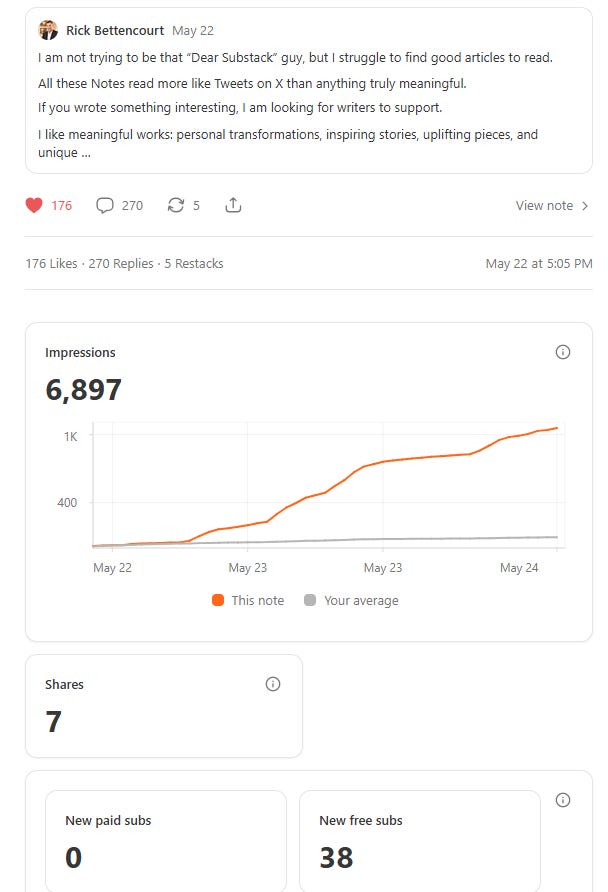
Some of my best-performing Notes created space for other writers to share what they were working on.
Keep Notes Short
Most strong Notes do not need to be long.
Many of the best ones are only a few lines.
They do not need to carry the full weight of your argument.
They only need to create a moment.
A short Note can name a feeling, offer a useful reminder, invite someone to share their work, or make a reader think, “I needed that today.”
For the most part, I try to keep mine to three or four short lines.
The point is not to say everything.
The point is to say enough.
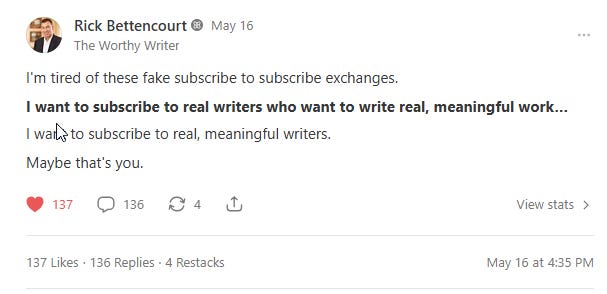
A strong Note does not have to be long. Often, the best ones create a small opening.
Use AI for Angles Rather Than Your Voice
Once I know the general themes I want to write about, I often use an AI tool to help me further.
I use AI to generate angles.
Not to replace my voice.
Not to write everything for me.
Not to turn my Notes into generic content sludge.
I use it to help me find angles.
If I’m aiming for four to five Notes per day, I need roughly 30 to 35 Notes for the week. That sounds like a lot, but it becomes easier when you stop trying to invent each Note from scratch.
I typically start with a prompt such as:
Act as my Substack Notes brainstorming partner.
I don’t want you to write polished Notes for me.
I want help finding strong angles, hooks, and directions I could turn into Substack Notes myself.
My audience is: [describe your audience]
My topic, idea, draft, or article excerpt is: [paste your idea]
Give me 15 possible Substack Note angles based on this idea.
For each angle, include:
A short hook idea
The core point of the Note
Why this angle might resonate
The emotional tone: useful, personal, provocative, encouraging, reflective, or practical
A suggested first line I could build from
Do not write full Notes unless I ask.
Prioritize angles that are:
Clear
Human
Specific
Shareable
Relatable to my audience
Strong enough to make someone think, “I wish I had said that.”
Avoid generic advice, hype, hashtags, and engagement bait.
At the end, tell me which 5 angles are strongest and why.
From there, I’ll iterate the above several times, tweaking each angle to my liking.
At this stage, I am not trying to make every Note perfect.
I am trying to create options.
The goal is to create more possibilities than you need, then refine and write the strongest ones.
I keep mine in a simple working document before I schedule them.
Schedule the Batch
Once I have my weekly list of Notes, I move into Substack and schedule them.
Instead of logging in several times a day and asking, “What should I post now?” I make those decisions upfront.
I sit down once.
I review the list.
I choose the strongest Notes.
I schedule them across the week.
Inside the Substack Note composer, there is a small scheduling icon near the bottom of the Note. It looks like a calendar. When you click it, you can choose the date and time you want the Note to publish.
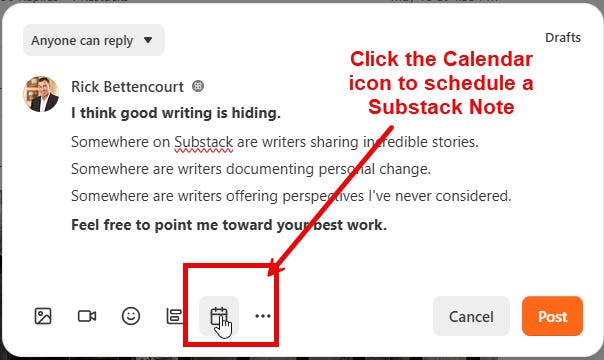
The scheduling icon appears at the bottom of the Note composer.
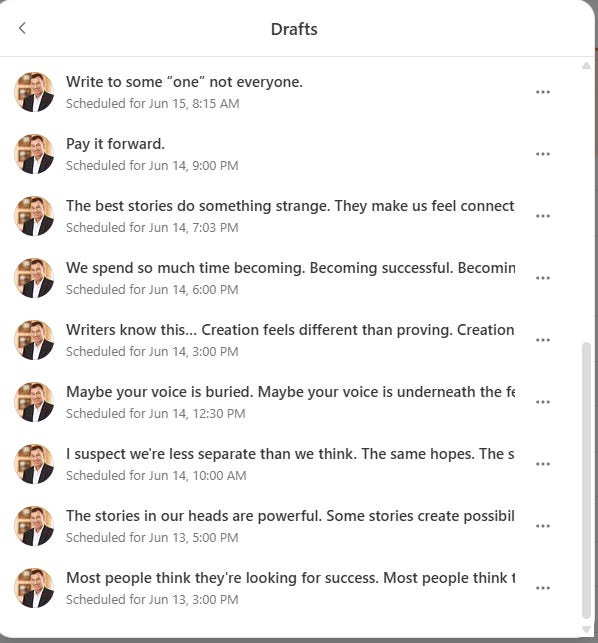
After that, go to your Drafts area to see the Notes you have queued up. This lets you check how they are spaced throughout the week and make sure you do not have too many similar Notes clustered together.
If you have a lot of Notes, you may need to scroll to the bottom of your list and click the Load More button, particularly if you’re on a mobile device.
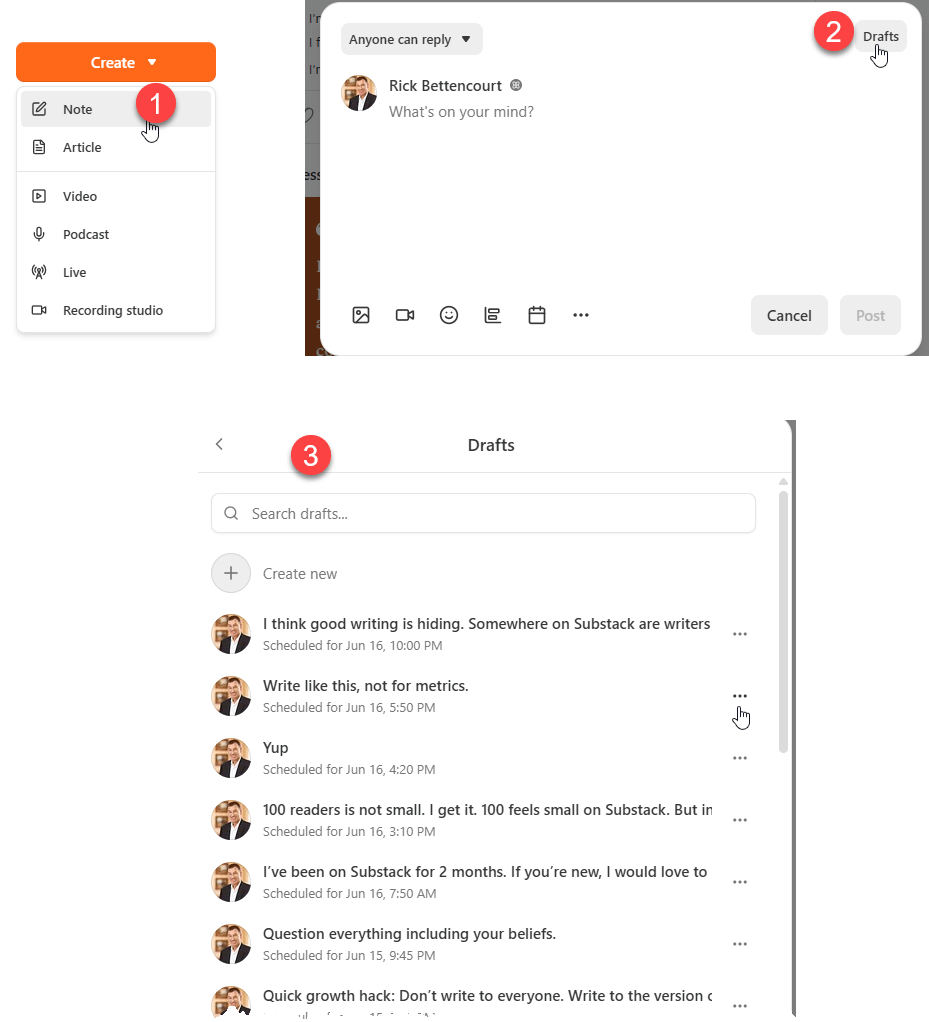
Drafts lets you review scheduled Notes before publication.
That is the main benefit of batching.
You are not only saving time.
You are creating a better rhythm.
You can spread out encouragement, invitations, personal observations, and teaching Notes so your feed feels varied instead of repetitive.
For me, this makes Notes feel less like another daily obligation and more like a simple publishing system.
Why Notes Matter
The real secret is not complicated.
Write short Notes.
Write them for the reader.
Batch them so you are not constantly scrambling.
Schedule them so they publish consistently.
Pay attention to what creates connection.
The best Notes are rarely the ones where you try to prove how impressive you are.
The best Notes are the ones that make someone feel seen.
They are small.
But small invitations, offered consistently, can grow into real audience connection.
That was Rick’s whole Substack breakdown. :D
For more on Rick Bettencourt, check out his free publication The Worthy Writer.
He shares practical ideas and honest encouragement to help writers create, publish, and promote meaningful work.
See ya soon
Timo Mason🤠
Liked this post? 2 ways you can support me
Share it with a creator friend who will benefit.
Ask a question or share your thoughts in the comments.
 | A guest post by
|