

How To Write The Perfect Substack Welcome Email To Build Trust From Day One
5 mistakes to cut, 5 proven frameworks to model, and 5 copy-paste prompts to make yours


Howdy, Wealth Gang🤠

Your welcome email is the most important email you will ever send, but most Substack creators treat it like a… receipt.
“Thanks for subscribing, see you Thursday”
And that’s it, the moment is gone.
The second someone subscribes, they are paying more attention to you than they ever will again, and what you do with that moment shapes the entire future of your relationship with that reader.
Today’s guest author Vinayak Ramesh subscribed to five big newsletters:
Dan Koe
Nicolas Cole
Matt McGarry
Codie Sanchez
Harry Dry
Vinayak studied how the greats structure their welcome emails, and what he found is that all five use completely different strategies but have one thing in common, which most mediocre creators fully miss.
What you’ll learn today:
✓ The 5 mistakes that are killing most Substack welcome emails right now
✓ 5 proven welcome mail frameworks you can model for your own newsletter
✓ 5 copy-paste prompts for each welcome email style so you can create your own
You can see 555 is the angel number of today’s post, so it can only be great. :D
Let’s goo! 🤠

Imagine this.
You find a newsletter that looks genuinely interesting. You click subscribe. And within thirty seconds, something arrives in your inbox.
What happens in that moment — what you read, how it makes you feel, whether you reply or close the tab shapes the entire future of your relationship with that creator.
Most Substack writers treat that moment like an afterthought. They write a two-line “thanks for subscribing, see you next Thursday” and wait for their newsletter cadence to do the heavy lifting. Then they wonder why open rates slowly drift south and free readers never convert to paid.
The welcome email is not a courtesy. It is your reader’s first experience of what you are actually like — at the exact moment they are paying the most attention they ever will.
I subscribed to five major newsletters specifically to study what happens in that window. DAN KOE . Nicolas Cole . Matt McGarry . Codie Sanchez. Harry Dry . Five completely different strategies. Five distinct psychological mechanisms. And underneath all of them, one thing they all get right that most Substack creators never think about.
But first — the five mistakes.
The 5 Things Killing Most Substack Welcome Emails Right Now
Before we get to what the best creators do, here is what almost everyone else is doing. You may recognize yourself in more than one of these.
Mistake 1: Treating the welcome email like a receipt
“You’re subscribed! I’ll be in your inbox every Thursday.” That is not a welcome. That is a confirmation email. It answers the question “did it work?” and nothing else. The reader closes it and immediately forgets you exist.
Mistake 2: Pitching paid before earning anything
Some creators swing to the other extreme. The welcome email includes an upgrade button in the first paragraph. The reader has been on your list for thirty seconds. They do not know you, do not trust you, and have not seen what you actually produce. Asking for money at this stage is like proposing on a first date. Even if the answer might eventually be yes, the timing destroys the possibility.
Mistake 3: Burying the best work in the archive
Your new subscriber does not know your greatest posts exist. They subscribed because one thing caught their attention but they have not seen the work you are most proud of. Most creators let new readers find the good stuff by accident, over months, if they stick around. The best creators surface it immediately and deliberately.
Mistake 4: Writing an origin story that nobody asked for
“I grew up in a small town and always loved writing” is not what a new subscriber is looking for. An origin story in a welcome email only works when it makes the reader feel seen — when it mirrors back the situation they are in right now. If your story does not do that, it is a vanity exercise wrapped in a first-person narrative.
Mistake 5: Disappearing after the first email
A single welcome email followed by your weekly newsletter is not a system. It is a hope. The creators who consistently convert free readers to paid subscribers have built a deliberate sequence — not one email, but several that do specific jobs in a specific order before a single pitch is ever made.
Now. Here is what five newsletter operators who have actually figured this out are doing instead.
Creator 1: DAN KOE — The Shared Mission Frame
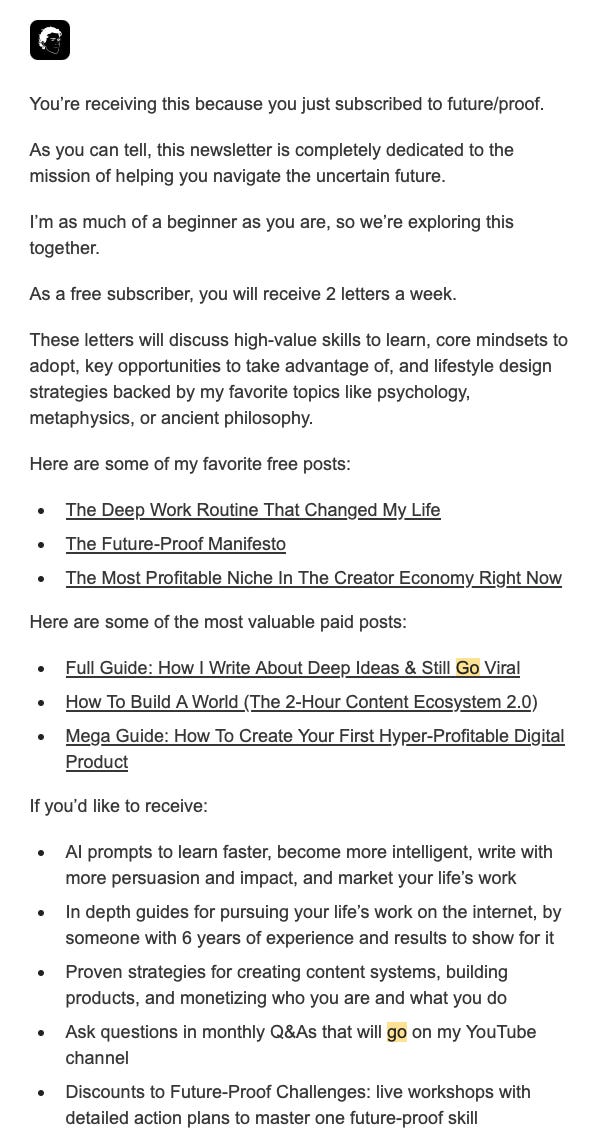
Picture the moment you subscribe to future/proof for the first time.
The first thing Koe tells you is not who he is or what his credentials are. It is something far more disarming: “I’m as much of a beginner as you are, so we’re exploring this together.”
That single line does something most welcome emails fail to do. It immediately eliminates the guru-student dynamic. You are not enrolling under a teacher. You are joining someone navigating the same uncertain future you are — through psychology, metaphysics, ancient philosophy, and whatever high-value skills will still matter ten years from now.
Then he does something deliberate: he separates free from paid posts and names specific articles for each tier. Three free posts. Three paid posts. No pressure, no hierarchy. He is not hiding the paid tier, but he is not selling it either. He is showing you both worlds and trusting you to move toward one.
By the end, you are not wondering whether to stay. You are already reading the post links.
What is actually happening:
There is a well-studied dynamic in behavioral psychology around intellectual companionship — the tendency to feel a stronger bond with someone who is openly navigating the same uncertainty you are than with someone who presents themselves as having all the answers.
Gurus attract followers. Co-explorers attract communities.
When Koe says “I’m a beginner too,” he is not being modest. He is sorting his audience. The reader who responds to that framing is the reader who values authentic inquiry over confident instruction. That reader is more likely to engage, more likely to reply, and more likely to pay because they have found someone whose way of thinking resembles their own.
The philosophy is the worldview. It does not need to be proclaimed loudly. It is embedded in every topic he mentions: psychology, metaphysics, ancient philosophy, the uncertain future. Specific enough to exclude some people. Resonant enough to pull in the ones who belong.
The Substack lesson:
The “I’m figuring this out too” opener is one of the most underrated moves in a welcome email — if it is honest. Performative humility reads hollow immediately. But genuine intellectual companionship, built around a shared curiosity or mission, creates a different quality of reader relationship than authority alone.
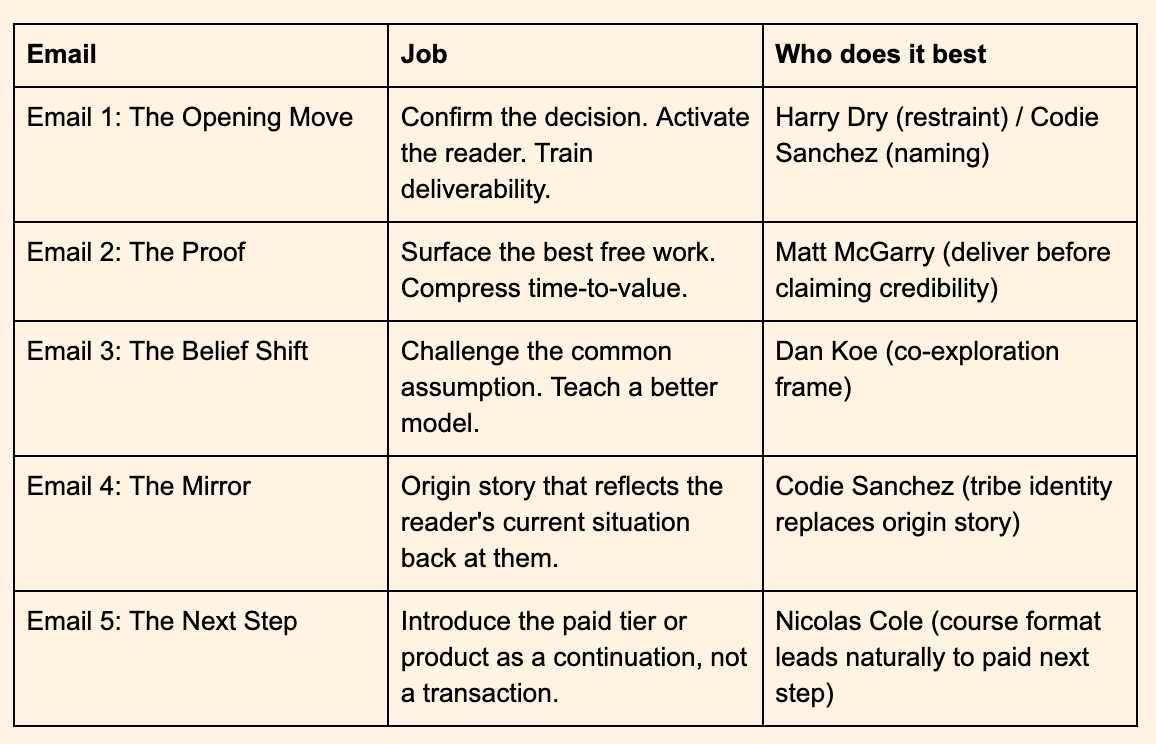
What this maps to in the 5-email framework (explained later in this post):
Koe runs Emails 1, 2, and 3 in a single email. He establishes the shared mission (Email 1 — Warm Welcome), surfaces his best free and paid content (Email 2 — Greatest Hits), and the philosophical framing challenges conventional productivity assumptions (Email 3 — Belief Shift). The economy is remarkable.
The Prompt:
Paste this into Claude or ChatGPT:
“I run a newsletter called [name] about [your topic]. My genuine belief about this topic is: [one honest sentence about what you’re still figuring out — something true and specific, not polished]. Write the opening 3 paragraphs of my welcome email. Position me as someone on the same journey as my readers, not as someone who has arrived. Include: one line that names what we’re exploring together, the core philosophy or lens that shapes how I cover this topic, and a brief mention of 2-3 free posts and 1-2 paid posts for new subscribers to find. Tone: intellectually warm, no hype, reads like one person writing to another person they respect.”
Creator 2: Matt McGarry — The Earn Before You Ask
Here is something most newsletter writers are afraid to admit: your new subscriber does not trust you yet.
They subscribed, which means they are interested. But interest and trust are different things. Interest says: this looks worth checking out. Trust says: this person’s judgment is worth following.
McGarry knows the difference and his welcome email for Newsletter Operator is built around earning trust in the right order.
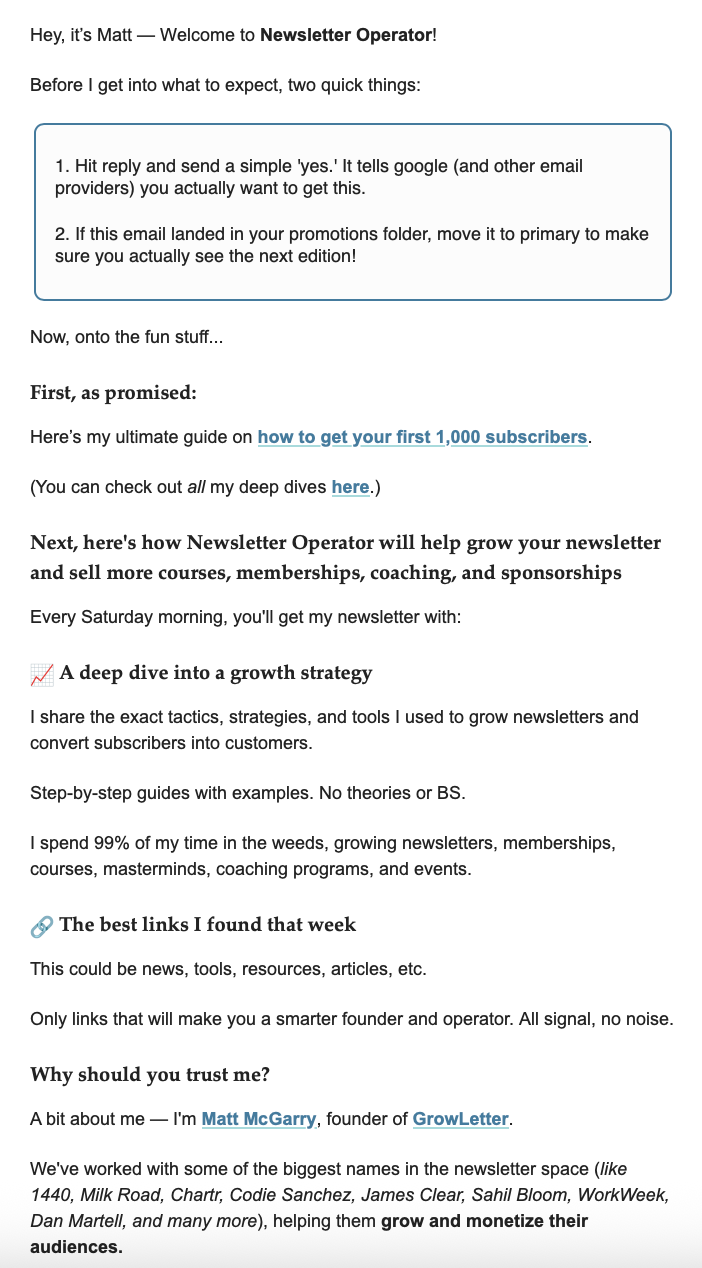
The first thing you see is not a credentials section. It is a box with two practical asks: reply with a simple “yes” (for deliverability), and move the email to Primary if it landed in Promotions. No selling, no biography. Just two things that make the newsletter actually reach you.
Then, before McGarry says a single word about himself, he delivers on his promise: here is my ultimate guide on getting your first 1,000 subscribers. Already gave you something.
After that, he explains what you will get every Saturday morning: a deep-dive growth strategy and the best links he found that week. Then — and only then — does he answer the question: Why should you trust me?
He names his clients. Not generically. By name: 1440, Milk Road, Chartr, Codie Sanchez, James Clear, Sahil Bloom, WorkWeek, Dan Martell. These are names any serious newsletter operator recognizes. The trust transfers in seconds.
What is actually happening:
Behavioral economists have documented something called reciprocity bias — the documented human tendency to feel more favorably toward someone after they have given us something, even something small. McGarry’s welcome email is a study in using this deliberately.
By the time you reach his “Why should you trust me?” section, you already have a free guide in your hand. The credibility information now feels like supporting context, not a pitch.
Flip that sequence — credentials first, guide second — and the email reads as an audition. Credentials first says: please trust me enough to open the resource I’m offering. Give the guide first, then credibility section says: here is the resource I promised, and here is the context for why it’s worth your time. The second version is harder to dismiss.
There is something else worth noticing about the client list. Seeing “Sahil Bloom” and “James Clear” in the same sentence as a newsletter growth consultant is not bragging — it is a shortcut. When a reader sees names they already trust, credibility transfers in a way that paragraphs of self-description never could.
The Substack lesson:
If you promised a free resource when someone subscribed — a guide, a template, a checklist — deliver it before you say anything about yourself. The sequence matters more than the content. Give first, then ask for trust.
What this maps to in the 5-email framework:
McGarry compresses the Greatest Hits email (Email 2) into the first email, but he earns the right to show credentials by delivering value first. The “Why should you trust me?” section is labeled explicitly — which is unusually direct and unusually effective. Most creators bury the answer to this question. McGarry asks it out loud.
The Prompt:
Paste this into Claude or ChatGPT:
“I run a newsletter about [topic]. Write me a welcome email that follows this exact sequence: First, a deliverability box — one simple, clear request to reply or move to Primary, no more than 2 sentences. Second, deliver my free resource — introduce it warmly and link to it without over-explaining. Third, explain what future issues will contain — specific, not vague, 3-4 sentences maximum. Fourth, a section that answers ‘Why should you trust me?’ — name specific results, clients, publications, or experiences that are directly relevant to what I teach. Each section should be 3-5 sentences maximum. The credibility section should feel like it is answering a question the reader is silently asking, not like a bio.”
Creator 3: Nicolas Cole — The Course Conversion
Here is what most newsletter operators do when someone subscribes: they send a welcome email.
Here is what Nicolas Cole does: he sends a course invitation.
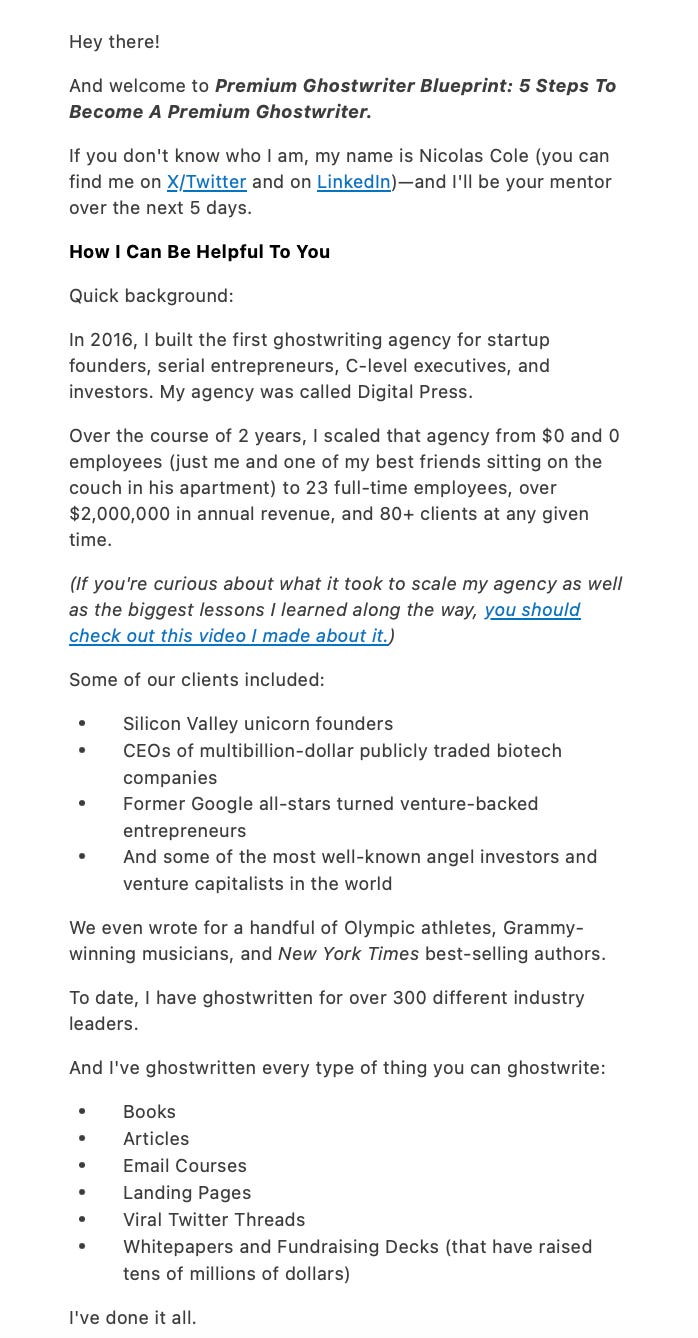
When you subscribe to the Premium Ghostwriting Blueprint, the first sentence reads: “I’ll be your mentor over the next 5 days.”
Not welcome to my newsletter. A mentorship. A five-day commitment. A curriculum.
This framing change sounds small. Its effect on reader behavior is not.
When someone identifies as a newsletter subscriber, they have made a soft, passive commitment. When they identify as a student in a five-day course, they have made an active one. Students show up. Students expect lessons. Students feel the mild psychological weight of an uncompleted course when they skip a day. Subscribers sometimes open emails.
Then comes the credentials — and Cole does not hold back. Digital Press, his ghostwriting agency for startup founders and C-level executives. Scaled from zero to $2 million in annual revenue. 23 full-time employees. 80+ clients. Silicon Valley unicorn founders. CEOs of publicly traded biotech companies. Former Google executives. Some of the world’s most recognized angel investors. Olympic athletes. Grammy-winning musicians. New York Times bestselling authors. Over 300 industry leaders.
He lists everything. Books, articles, email courses, landing pages, viral Twitter threads, whitepapers, fundraising decks that raised tens of millions of dollars.
What is actually happening:
The scale and variety of Cole’s credential list is not accidental. This is not a modest bio — it is a systematic demonstration of range.
In any specialized field, the question a new reader is silently asking is not just “are you good at this?” but “are you good at this for someone like me?” By listing Silicon Valley founders alongside Grammy-winning musicians alongside Olympic athletes alongside NYT bestselling authors, Cole is eliminating every possible version of that doubt. The answer is always yes.
In consumer psychology, this is called comprehensive authority — trust built not through depth in a single domain but through undeniable breadth across many. It is harder to establish than specialist credibility, but it is also harder to dismiss.
The second mechanism is the course frame itself. When you call it a 5-day course, you set a completion expectation. A newsletter is indefinite. A course has an ending, which makes starting it feel easier. You are not committing to a subscription — you are committing to five days. And once someone completes the course, they are already subscribed, already trusting, already familiar with Cole’s voice and thinking.
The Substack lesson:
You do not need 300 clients to use the email course format. You need five good emails and a promise worth keeping. If your content can be structured as a progression — from problem to solution, from beginner to confident, from question to clarity — you can offer a course instead of a newsletter and watch open rates climb.
What this maps to in the 5-email framework:
Cole builds the entire five-email framework into the course structure. Email 1 is the course orientation. Email 2 is the first lesson (delivered through the lens of his credentials). Emails 3 and 4 are the belief-shifting lessons. Email 5 is the natural next step — not a pitch, but a “you have completed the free course, here is what comes next.” The sequence feels inevitable because it is designed to be.
The Prompt:
Paste this into Claude or ChatGPT:
“I run a newsletter about [topic] and want to frame my welcome sequence as a 5-day email course. Help me with three things: First, write the opening line for my welcome email that positions me as a mentor for the next 5 days — it should feel like an invitation to a real learning experience, not a marketing device. Second, based on my topic [describe what you cover], suggest 5 lesson titles that would work as a 5-day sequence — each one should solve a specific problem for a new subscriber. Third, write a credential section of 4-6 sentences that demonstrates my range or depth without reading like a bio — frame it around: here is why I am the right person to teach you this over the next 5 days.”
Creator 4: Harry Dry — The Confidence of Saying Less
There is a welcome email in your inbox right now that you have not read.
You know the one. Someone’s newsletter you signed up for six months ago, meaning to get into it. The welcome email was long — an origin story, a list of best posts, a breakdown of what to expect, a paid upgrade mention. You skimmed it. Told yourself you’d come back. Never did.
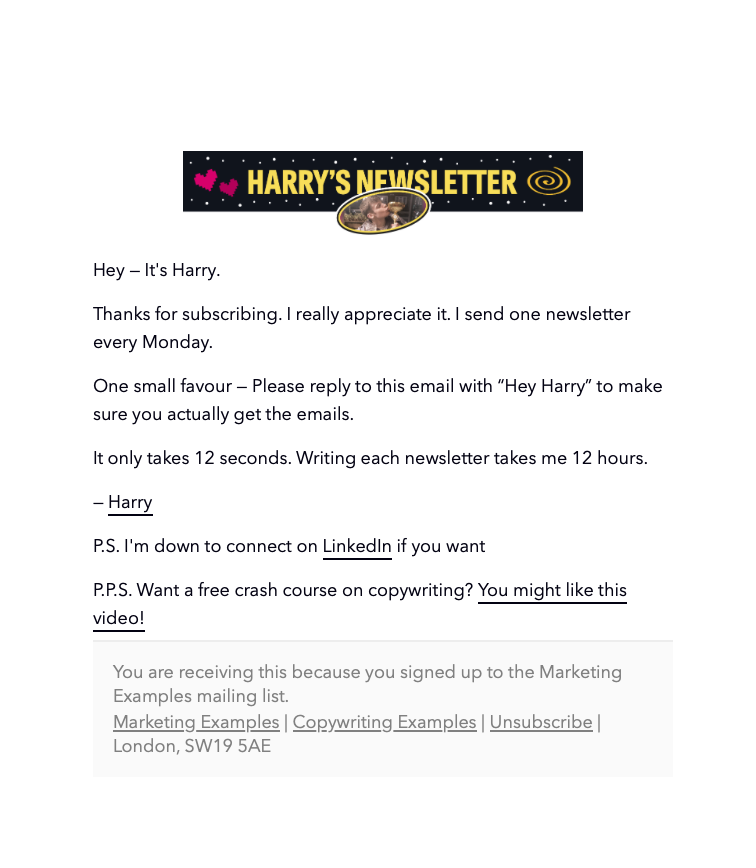
Harry Dry’s actual welcome email for Marketing Examples is four sentences in the body.
Hey — It’s Harry. Thanks for subscribing. I really appreciate it. I send one newsletter every Monday. One small favour — please reply to this email with “Hey Harry” to make sure you actually get the emails.
Then comes the line that makes this email remarkable: “It only takes 12 seconds. Writing each newsletter takes me 12 hours.”
That is it. Signed off personally as “Harry” — not a brand name. Then a P.S. offering to connect on LinkedIn. Then a P.P.S. linking to a free crash course on copywriting. Both tucked into postscripts, never interrupting the body.
And somehow, Marketing Examples has become one of the most-shared, most-recommended newsletters in the marketing world.
What is actually happening:
There is an inverse relationship between the length of a welcome email and the implied confidence of its author.
Think about why welcome emails get long. It is almost always anxiety. Anxiety that the reader will leave without the origin story. Anxiety that without a curated resource list, they won’t know where to start. Anxiety that unless the value is proven in the first email, the subscriber might drift. Length is an anxiety signal. Brevity is the opposite.
But the real genius in Dry’s email is not the length — it is the 12-seconds-versus-12-hours contrast. In one sentence, he reframes the deliverability ask entirely. He is not just asking you to reply. He is presenting the arithmetic of the relationship: you give 12 seconds, he gives 12 hours. That is an asymmetric trade in your favor, and he states it plainly enough that you feel it immediately.
That framing does two things at once. It makes replying feel trivial (12 seconds) and it signals quality before you have read a single issue (12 hours of effort, every week). Most creators ask for the deliverability reply and hope the reader complies. Dry gives the reader a reason to want to.
There is also something in how he signs the email. Not “The Marketing Examples Team.” Not a brand signature. Just “Harry.” One person, writing to one person. At the scale he operates, that choice is deliberate.
The P.S. and P.P.S. lines are worth noting too. He does surface value — LinkedIn access, a free copywriting course — but he buries them after the sign-off. They are there for the reader who wants more, invisible to the reader who does not. No pressure, no list, no architecture. Just two quiet doors left open.
The Substack lesson:
Ask yourself this about your current welcome email: is it this long because the content demands it, or because you are nervous? Cut it in half. Then read what is left. The compressed version is usually more honest and more compelling than the original.
If you do keep it short, find your own 12-seconds-versus-12-hours line. The contrast that shows you are giving far more than you are asking. That one sentence does more work than most welcome emails do in 600 words.
This approach requires something most frameworks cannot give you: a newsletter good enough that the work does the convincing. If your newsletter consistently makes readers forward it and say “read this” — a short, confident welcome email will outperform an elaborate sequence. If you are still finding your voice, the five-email framework gives you more runway.
What this maps to in the 5-email framework:
Dry collapses Email 1 into its essential core: deliverability signal, expectation setting, one quality promise. The P.S. and P.P.S. are a lightweight version of Email 2 (Greatest Hits) — there if you look, not forced on you. He skips Emails 3 through 5 — not because they do not matter, but because his newsletter earns that trust in every issue rather than front-loading it in the onboarding. It is a different bet. For most Substack creators at early stages, the five-email sequence is the safer one.
The Prompt:
Paste this into Claude or ChatGPT:
“Here is my current Substack welcome email: [paste it here]. I want to test a shorter, more confident version inspired by Harry Dry’s approach. Do three things: First, rewrite it in under 5 sentences in the body. Keep only what is genuinely essential — remove anything that sounds like justification, apology, or an attempt to convince the reader to stay. Sign it with your first name only. Second, write my version of the ‘12 seconds vs 12 hours’ line — a single sentence that contrasts the small ask I’m making of the reader with the effort I put into each issue. Make it feel honest, not like a pitch. Third, write two postscript lines: one that offers a connection point (LinkedIn, reply, community), and one that surfaces a single free resource — both should feel like options, not obligations.”
Creator 5: Codie Sanchez — The Tribe Induction
Think back to the last time someone called you something and it stuck.
Not a label slapped on from outside. Something that felt true — a word that named something you already believed about yourself but had not found the language for yet.
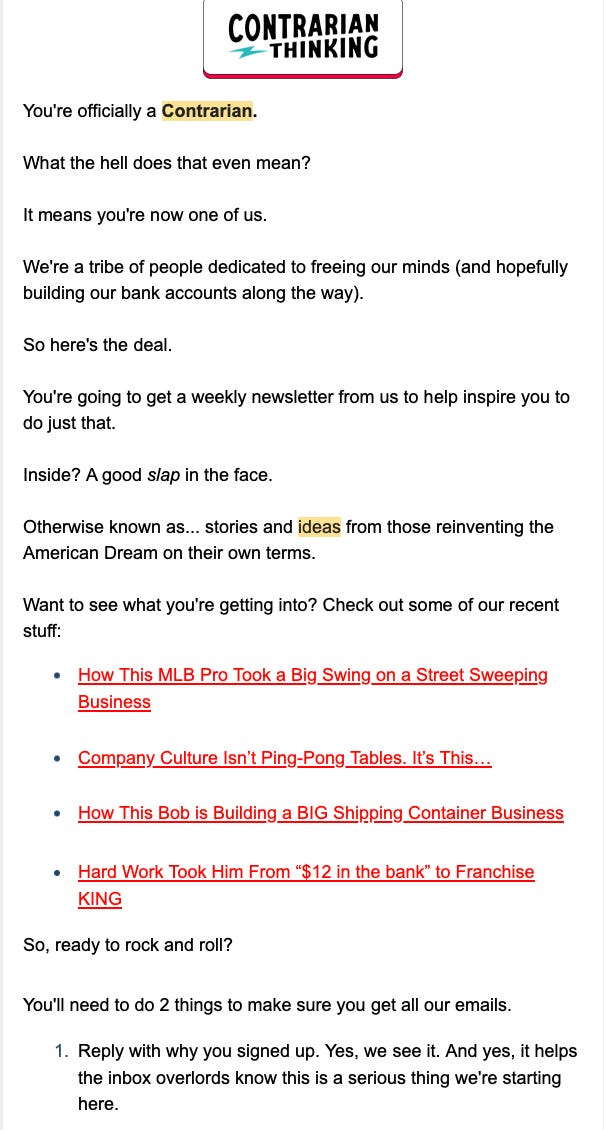
That is what Codie Sanchez does in the first three sentences of her Contrarian Thinking welcome email.
“You’re officially a Contrarian.”
“What the hell does that even mean?”
“It means you’re now one of us.”
Three sentences. Three moves. First she gives you a name. Then she anticipates the resistance to it. Then she reframes the answer — not as a definition of the newsletter, but as belonging: you’re one of us. The word “officially” is doing quiet work here too. You did not just subscribe. You were inducted. There is a difference.
What follows is simple: a quick description of the weekly newsletter, links to a handful of recent posts, and two asks at the end (reply with why you signed up, move the email to Primary). But none of that is the point. The work was done in those first three lines.
What is actually happening:
In the 1970s, researchers showed that people who were told “you seem like the kind of person who votes” before an election voted at significantly higher rates than people who were simply asked to vote. The mechanism was not persuasion. It was label attachment — the human drive to behave in ways consistent with how we have been named.
Sanchez’s “you’re officially a Contrarian” is not a branding flourish. It is a behavioral commitment device. The reader who accepts the label — even passively, by continuing to read — has made a low-level decision: I am someone who thinks differently about money, opportunity, and conventional wisdom. That decision shapes every interaction they have with the newsletter going forward. Contrarians open emails because Contrarians stay informed. Contrarians engage because Contrarians participate. Contrarians eventually pay because Contrarians invest in themselves.
The “what the hell does that even mean?” follow-up is worth examining on its own. Most newsletter names just hang there, unexplained. Sanchez anticipates the skepticism and names it out loud, which instantly makes her feel more real than a polished brand voice. Then she reframes: not a definition, but an identity. Not “it means you read this newsletter.” It means you’re one of us.
That is a significantly more powerful thing to say.
The Substack lesson:
You do not need hundreds of thousands of subscribers to name your tribe. You need a worldview specific enough that the name carries real meaning. A newsletter about sustainable solopreneur growth might call its readers “Slow Builders.” A newsletter about unhurried creativity might call its readers “The Understory.” The name does not have to be clever. It has to be true. When readers see themselves in it, they commit. When they do not, they leave — and that is the point.
The follow-up line matters just as much as the name. Name them, then tell them what being named means. Not as a description of your newsletter. As a declaration of who they are now.
What this maps to in the 5-email framework:
The tribe name does the work of Email 4 (Origin Story) inside Email 1. By naming the subscriber, Sanchez skips the “let me tell you about my journey” section entirely. The reader’s identity becomes the origin story. They are not learning about Codie’s path — they are being told who they are now. That is a significantly more powerful affinity-building move.
The Prompt:
Paste this into Claude or ChatGPT:
“I want to give my newsletter subscribers a name — a word or short phrase that captures who they are and what they stand for by being part of this newsletter. My newsletter is about [topic], built on the belief that [your core worldview in one sentence]. My ideal reader is someone who has rejected [the mainstream belief or path they have moved away from] and is building toward [what they want instead]. Do three things: First, give me 10 potential tribe names — avoid generic words like tribe, community, squad, or crew, and favor words that carry implicit values or describe a way of moving through the world. Second, for each name, write the first 3 sentences of a welcome email that uses the name to induct the reader — starting with ‘You’re officially a [Name],’ then anticipating their reaction, then reframing it as belonging. Third, recommend the strongest option and explain in 2 sentences why it is the most honest fit for this specific audience.”
What All Five Get Right
Five completely different philosophies. Five different reader relationships. One thing underneath all of them.
Every single one answers the reader’s unspoken first question before they know they are asking it.
The question is always the same: Did I make the right choice by subscribing to this?
Koe answers through a shared mission: Yes — because we are navigating this uncertainty together, and you have found someone asking the same questions you are.
McGarry answers through earned credibility: Yes — because I already gave you something, and the people behind the other newsletters I’ve grown trust me.
Cole answers through transformation: Yes — because you are not a subscriber, you are a student in a five-day mentorship from someone who has done this for 300 of the most credentialed people in the world.
Dry answers through restraint: Yes — because someone this unbothered about convincing you is usually the real thing.
Sanchez answers through identity: Yes — because you are a Contrarian, and Contrarians belong here.
The method differs. The job is identical.
Most Substack welcome emails do not answer this question at all. They confirm the subscription and wait for Thursday. The reader never consciously forms a doubt but they also never consciously form a commitment. And without commitment, every future email is fighting for attention in a crowded inbox.
Your 10-Minute Action
Five creators. Five approaches. One principle.
Open your current Substack welcome email. Read it from the perspective of someone who just subscribed and knows nothing about you.
Ask: by the end of this email, does the reader know why they made the right choice?
If the answer is no — or you are not sure — pick the prompt that maps to your newsletter’s personality:
Your newsletter is built around shared exploration of a philosophy or worldview — use the Shared Mission Frame (Koe)
You have a promised resource and verifiable results — use the Earn Before You Ask sequence (McGarry)
Your content can be structured as a progression from problem to clarity — use the Course Conversion frame (Cole)
Your newsletter competes on quality and voice above all else — use the Confidence of Saying Less edit (Dry)
Your newsletter has a distinct tribe or contrarian identity — use the Tribe Induction prompt (Sanchez)
Run the prompt. Replace what you have.
The welcome email runs automatically. It goes to every subscriber at the moment they are paying the most attention. It is the single highest-leverage email you will ever set up — and it only takes one afternoon to get right.

Liked this post? 2 ways you can support me
Share it with a creator friend who will benefit.
Ask a question or share your thoughts in the comments.
 | A guest post by
|
Enjoyed your article, I’ll take the info to heart as I settle into this new world of writing.
So valuable and full of helpful information Thank you...